Blue Pure 511i Review: Is the 511i Max Worth It?
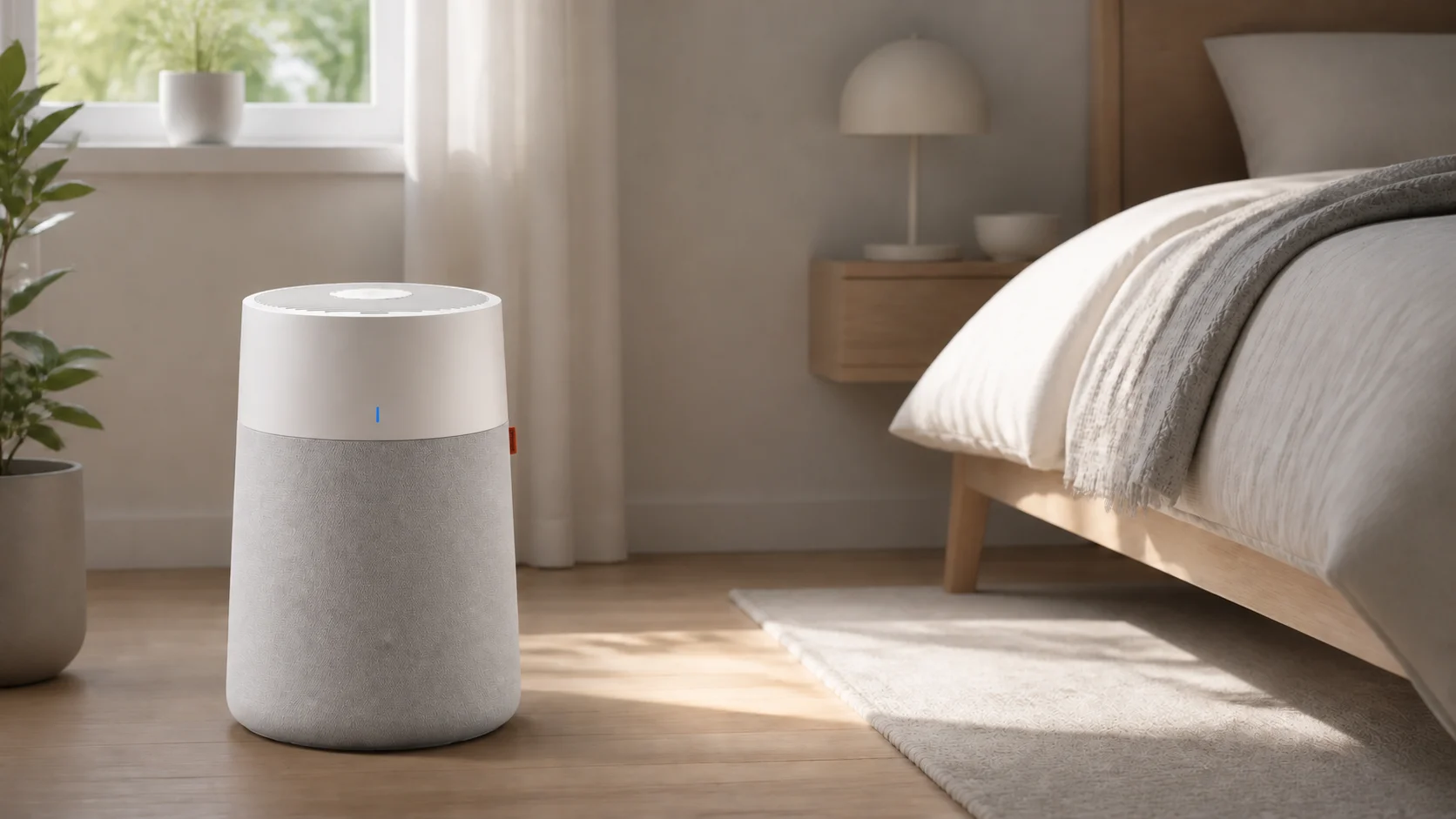
The Blueair Blue Pure 511i Max is easy to like if you want a compact, quiet air purifier for a bedroom or home office. It adds Wi-Fi, app controls, a PM2.5 sensor, Auto Mode, and Night Mode to Blueair’s small-room lineup without taking up much floor space.
But there is an important catch: this is still a small-room purifier. Blueair advertises coverage as high as 1,138 square feet when the purifier is given an hour to process that volume of air, but that number should not be interpreted as a recommendation for a 1,138-square-foot room. Independent testing and CADR-based sizing put the Blue Pure 511i Max much more comfortably in small-bedroom territory.
That distinction matters even more if you’re buying an air purifier for pets, allergies, or smoke, where faster air turnover is more useful than a large marketing coverage number.
BLUEAIR Blue Pure 511i Max
- Powerful air cleaning for small rooms
- Quiet, sleep-friendly performance
- Smart app control for dust, smoke, and pet dander

Quick Verdict
The Blue Pure 511i Max is a good choice for a roughly 150–235 sq. ft. closed bedroom or office if you value quiet operation and smart controls. Its biggest strengths are its compact design, useful Auto and Night modes, app connectivity, and respectable particle-cleaning performance for its size.
It is less compelling for a large or open-plan room, and the standard Particle & Carbon filter shouldn’t be mistaken for a heavy-duty odor filter. Pet owners should also understand that an air purifier can help with airborne dander and fine particles, but it won’t collect most visible pet hair from floors and furniture.
For a broader shortlist before choosing a model, see our best air purifiers for pets.
Pros
- Compact enough for bedrooms and small offices
- Quiet at lower settings
- Wi-Fi, app control, schedules, and Auto Mode
- PM2.5 air-quality sensor
- Washable fabric pre-filter
- Good particle-cleaning performance for its size
- Several official filter options
Cons
- Not a realistic large-room purifier despite the 1,138-sq.-ft. hourly claim
- Standard carbon filter is intended for relatively light household odors
- Replacement filters add recurring cost
- Published room-size and noise figures vary depending on source and test method
- Buyers looking specifically for a certified True HEPA filter should note that Blueair uses its HEPASilent system instead
First, Which Blueair 511 Are We Reviewing?
There is some genuine naming confusion around this product.
This review covers the Blueair Blue Pure 511i Max, the current smart model. Searchers often shorten the name to “Blue Pure 511i” or “Blueair 511i,” but the current U.S. product name includes Max.
The Blue Pure 511 is a different product. It remains a current model and is the simpler, less expensive option without Wi-Fi or an integrated air-quality sensor. The two models also shouldn’t be assumed to use interchangeable filters just because their names are similar.
For buyers, the distinction is fairly straightforward:
| Model | Best reason to choose it |
|---|---|
| Blue Pure 511 | Lower price and simple operation |
| Blue Pure 511i Max | Smart controls for a small bedroom or office |
| Blue Pure 311i Max | More airflow for a larger room |
If you’re specifically searching for a Blue Pure 511i review, the 511i Max is the model you should be evaluating.
How Much Room Can the Blue Pure 511i Max Really Handle?
This is the most important part of the review because published coverage numbers can be misleading without context.
Blueair currently describes the 511i Max as cleaning 237 sq. ft. in 12.5 minutes, 569 sq. ft. in 30 minutes, or 1,138 sq. ft. in an hour. Meanwhile, retailer-reported AHAM data lists smoke, dust, and pollen CADR at 125 CFM.
Those figures don’t perfectly reconcile under the same assumptions.
Using 125 CFM and an 8-foot ceiling, a straightforward CADR calculation gives approximately:
| Target air changes per hour | Approx. room size |
|---|---|
| 4.8 ACH | 195 sq. ft. |
| 4 ACH | 234 sq. ft. |
| 2 ACH | 469 sq. ft. |
| 1 ACH | 938 sq. ft. |
Independent testing provides another useful reference point. RTINGS measured 150 CFM PM1 CADR at maximum speed and calculated a 234-sq.-ft. room recommendation. When limiting the purifier to a quieter setting of no more than 45 dBA, RTINGS measured 95 CFM and recommended 149 sq. ft.
These measurements use different methodologies, so they shouldn’t be averaged together. What they do collectively show is that the 511i Max makes the most sense as a small-room purifier.
If your room is at the compact end of the range, compare it with other small air purifiers for pets before deciding.
For practical buying purposes, think roughly 150–235 sq. ft., particularly if you’re concerned about smoke, airborne pet dander, pollen, or other particles.
A 1,138-sq.-ft. open living area is a very different proposition. One nominal cleaning per hour is not the same as repeatedly filtering the room’s air.
How Well Does the Blue Pure 511i Max Clean the Air?
The 511i Max uses Blueair’s HEPASilent filtration system, which combines mechanical filtration with electrostatic particle capture.
Blueair says the system captures 99.97% of airborne particles down to 0.1 microns under its stated test conditions. Independent RTINGS testing also found particle-cleaning performance appropriate for a small-to-medium room.
The important distinction is terminology.
RTINGS reports that the filter in this model is not HEPA-certified, so it’s better to describe the product using Blueair’s actual term—HEPASilent—rather than calling it a certified “True HEPA” purifier.
That doesn’t mean it can’t remove fine airborne particles. CADR and independent particle testing indicate that it can. It simply means buyers shouldn’t confuse Blueair’s filtration technology and efficiency claim with a product-specific True HEPA certification.
Is the Blue Pure 511i Max Good for Pets?
For the right problem, yes.
The 511i Max is most useful for pet owners whose main concern is airborne dander, fine dust, and other particles in a small room.
Pet dander can remain suspended in the air and can be captured when it reaches the purifier. The washable fabric pre-filter can also catch some larger dust and hair that reaches the 360-degree intake.
For households managing allergy symptoms, our guide to air purifiers for pet dander compares more suitable options by use case and room size.
But an air purifier isn’t a vacuum.
Most visible cat or dog hair falls onto:
- Floors
- Bedding
- Sofas
- Carpets
- Clothing
The 511i Max won’t pull that hair across the room and remove it. Grooming, vacuuming, and washing fabrics remain necessary.
If visible shedding is the main problem, compare models designed around that use case in our best air purifiers for pet hair guide.
What about pet odors?
This is another area where expectations matter.
The standard Particle & Carbon filter is positioned by Blueair for light household odors from sources including pets, cooking, and smoke. Blueair also offers a SmokeBlock filter, which it says contains twice as much activated carbon as the standard filter.
That can help, but gas adsorption isn’t the same thing as particle filtration.
For a closer look at media capacity, saturation, and realistic odor expectations, read our guide to activated carbon filters for pet odors.
If your main problem is a strong litter-box smell, persistent dog odor, or another continuous odor source, the 511i Max shouldn’t be treated as a substitute for litter maintenance, cleaning, ventilation, or a purifier designed around substantially more gas-adsorption media.
For pet households, its strongest role is still particle control.
Is It Quiet Enough for a Bedroom?
Quiet operation is one of the better reasons to choose this model.
Blueair publishes a noise range of 19–42 dB, while independent measurements vary because testing methods and measurement positions differ. RTINGS measured 30.8 dBA at the low end and 53.9 dBA at maximum.
The exact numbers therefore shouldn’t be compared as if they came from the same test.
The broader evidence is more useful: lower-speed operation is consistently described as quiet, while maximum speed is noticeably more audible.
The purifier also includes Night Mode, making the 511i Max particularly well suited to buyers who plan to leave an air purifier running while they sleep.
If sleep-friendly operation is your top priority, compare it with other quiet air purifiers for pets as well.
If you need both low noise and higher particle removal, remember that reducing fan speed also reduces CADR. RTINGS’ quiet-setting result dropped from 150 CFM at maximum to 95 CFM at its ≤45 dBA setting.
That’s another reason to avoid undersizing the purifier.
Smart Features: App, Wi-Fi, Auto Mode, and PM2.5 Sensor
The smart features are the main reason to spend more on the 511i Max instead of the basic 511.
The 511i Max includes:
- Wi-Fi connectivity
- Blueair app control
- Scheduling
- Filter-life notifications
- Auto Mode
- Night Mode
- PM2.5 sensing
- Air-quality indicator
- Display/child-lock controls
Auto Mode allows the purifier to adjust operation based on its particle sensor, which is useful for a bedroom or office where you don’t want to constantly change fan settings manually.
However, the sensor should not be treated as an all-purpose pollution detector.
It measures PM2.5 particles. A smell, VOC event, or visible dust event doesn’t necessarily produce the response you might expect from a PM2.5 sensor. One hands-on review from Ideal Home, for example, reported mixed sensor responses during different household tests.
So the smart features are useful—but don’t confuse “air-quality sensor” with comprehensive gas and odor detection.
Filter Replacement and Long-Term Cost
Blueair lists filter life at up to nine months, although actual replacement timing depends on operating time, fan speed, and pollution conditions.
At the time the research for this review was collected, official one-time filter prices were:
| Filter | Price | Intended use |
|---|---|---|
| Particle & Carbon | $29.99 | Standard particle filtration + light odors |
| SmokeBlock | $38.99 | More activated carbon |
| AllergenBlock | $44.99 | Alternative allergen-focused filter |
| Fabric pre-filter | $8.99 | Washable/reusable outer pre-filter |
Prices can change, so check current pricing before buying.
Using the $139.99 list price recorded during research and assuming the standard $29.99 filter lasts nine months, the first 36 months would require three purchased replacement filters—at months 9, 18, and 27. The filter purchased at month 36 would begin year four, so it shouldn’t be counted in the first three years.
That produces a three-year core purchase-and-filter cost of about $229.96, before tax, shipping, and electricity.
Electricity is harder to estimate responsibly because the research did not identify a verified average operating wattage. Any electricity-cost figure therefore depends heavily on fan speed and usage pattern.
One more warning: don’t buy a Blue Pure 511 replacement filter simply because the product names look similar. Verify that the filter specifically lists compatibility with the 511i Max.
What Owners and Independent Reviewers Like—and Dislike
Across independent testing, editorial reviews, and clearly identified owner reports, several themes repeat.
Owners and reviewers commonly appreciate the 511i Max for being compact, unobtrusive, and quiet at lower settings. The app and automatic operation are also useful for people who want a purifier they can largely leave running in the background.
The recurring limitations are more important for deciding whether you should buy it.
The biggest is airflow. Buyers who expect the 511i Max to clean a large or open room aggressively are more likely to be disappointed. Replacement-filter cost is another ongoing consideration, and the similar naming between the 511 and 511i Max can create filter-compatibility confusion.
Odor performance also deserves realistic expectations. The standard filter contains carbon, but this is not a high-capacity gas-removal machine.
Blue Pure 511 vs. 511i Max: Which Should You Buy?
Choose the Blue Pure 511 if your priority is a simple, inexpensive purifier for a small room and you don’t care about Wi-Fi, automatic sensing, or app controls.
Choose the 511i Max if you specifically want:
- PM2.5 sensing
- Auto Mode
- Wi-Fi/app control
- Scheduling
- Night Mode
- Smart filter tracking
The 511i Max isn’t simply “the 511 with Wi-Fi,” though. Treat them as separate models, especially when buying replacement filters.
Should You Step Up to the Blue Pure 311i Max?
For many buyers, this is the more important comparison.
If your room is comfortably within the small-bedroom range, the 511i Max is easier to justify because it’s compact and less expensive.
If you’re trying to purify a larger bedroom or living space, the 311i Max makes more sense because the upgrade is primarily about airflow and room capacity, not merely getting additional smart features.
For smoke, allergy particles, or pet dander, buying a larger purifier and running it at a moderate speed can also be preferable to forcing a smaller purifier to operate near maximum speed.
Final Verdict: Is the Blue Pure 511i Max Worth It?
The Blueair Blue Pure 511i Max is worth considering for a small bedroom, home office, dorm, or similarly enclosed space where quiet operation and smart controls matter.
Its strongest case is straightforward: it combines useful particle-cleaning performance with a compact footprint, low-speed quietness, PM2.5 sensing, Auto Mode, and app controls.
Its weakest case is equally clear: don’t buy it because you saw “up to 1,138 sq. ft.” and assume it will perform like a large-room purifier. The available CADR data and independent testing support a much smaller practical room size when meaningful air turnover matters.
For pet owners, it can be a good airborne dander and particle purifier, but it won’t replace vacuuming for pet hair or source control for strong odors.
Best for: small bedrooms and offices, light-to-moderate particle control, pet dander, and buyers who value smart features.
Skip it if: you have a large/open room, strong persistent odor problems, or specifically require a product with verified True HEPA certification.
For those buyers, stepping up to a larger purifier—or choosing one designed around the specific filtration requirement—is the better move.
FAQ
Is the Blue Pure 511i the same as the Blue Pure 511i Max?
For the current U.S. product covered here, Blue Pure 511i Max is the official product name. “511i” is commonly used as shorthand. The basic Blue Pure 511 is a separate non-smart model.
How often do you replace the Blueair 511i Max filter?
Blueair says the main filter can last up to nine months, with actual life depending on use and pollution conditions.
Is the Blue Pure 511i Max good for pet hair?
It may catch some hair that reaches its intake, but it shouldn’t be bought primarily for visible pet hair. Most pet hair settles on surfaces and is better handled with grooming and vacuuming. Its stronger pet-related use is reducing airborne dander and fine particles.
Does the Blue Pure 511i Max remove pet odors?
The standard Particle & Carbon filter is intended for light household odors, and Blueair offers a SmokeBlock option with more activated carbon. Strong or continuous pet and litter-box odors still require source control and may call for substantially more gas-adsorption capacity.
Is the Blue Pure 511i Max a True HEPA air purifier?
Blueair calls its technology HEPASilent, combining mechanical and electrostatic filtration. Blueair claims 99.97% particle removal down to 0.1 microns under its test conditions, but the research collected for this review did not verify product-specific True HEPA certification.
Is the Blue Pure 511i Max suitable for 1,138 square feet?
That figure refers to Blueair’s one-hour coverage claim. It should not be interpreted as a strong particle-control recommendation for a 1,138-sq.-ft. room. The available evidence supports treating the 511i Max primarily as a small-room purifier.