HEPA Air Purifier for Cat Litter: Dust, Odor & Ammonia Guide
Yes—when it is sized for the room, a HEPA air purifier for cat litter can help reduce airborne litter-related particles after they enter the air. It does not, by itself, remove litter-box odor compounds or gaseous ammonia. For odor control, look for gas-phase filtration, such as activated carbon or another medium designed for gases.
That distinction matters because a litter box can create more than one indoor-air problem. A purifier can supplement prompt scooping, cleaning, litter handling, ventilation where appropriate, and filter maintenance. It cannot replace them.
Quick Answer
- HEPA and other mechanical filters target airborne particles, not gases.
- CADR is a particle-cleaning metric that helps with room sizing; it is not an odor or ammonia rating.
- General litter-box odor calls for gas-phase media, not HEPA alone.
- Activated carbon being present does not prove ammonia removal; media chemistry and independent product evidence matter.
- Source control still matters: for clumping litter, Cornell recommends daily removal of feces and clumps.
- Product documentation varies widely in how clearly it describes gas-phase media, carbon quantity, and replacement needs.
For a product-by-product shortlist focused on litter-box odor, compare our best air purifiers for litter box smell.
Which Problem Are You Solving?
Dust from litter handling: Prioritize particle filtration and a published CADR matched to the room.
Lingering litter-box odor: Evaluate gas media by disclosed type, amount, and replacement needs.
Ammonia concern: Seek pollutant-specific documentation; generic carbon is not proof.
Do Air Purifiers Work for Cat Litter?
They can, but only when the purifier feature matches the pollutant and the room. “Cat litter” is not one single thing in the air.
| Litter-box problem | What is in the air? | Relevant purifier feature | Important limitation |
|---|---|---|---|
| Litter dust | Airborne particles during activities such as pouring or handling | Particle filtration and adequate particle-cleaning airflow | Does not address gases |
| Cat allergen/dander | Airborne particle-associated material | Particle filtration | Do not treat allergen evidence as litter-dust evidence |
| General litter-box odor | Gas-phase compounds may contribute | Gas-phase media | Media performance and service life vary |
| Ammonia | Gas | Appropriate sorbent chemistry and directly relevant evidence | Ordinary carbon presence is not proof of performance |
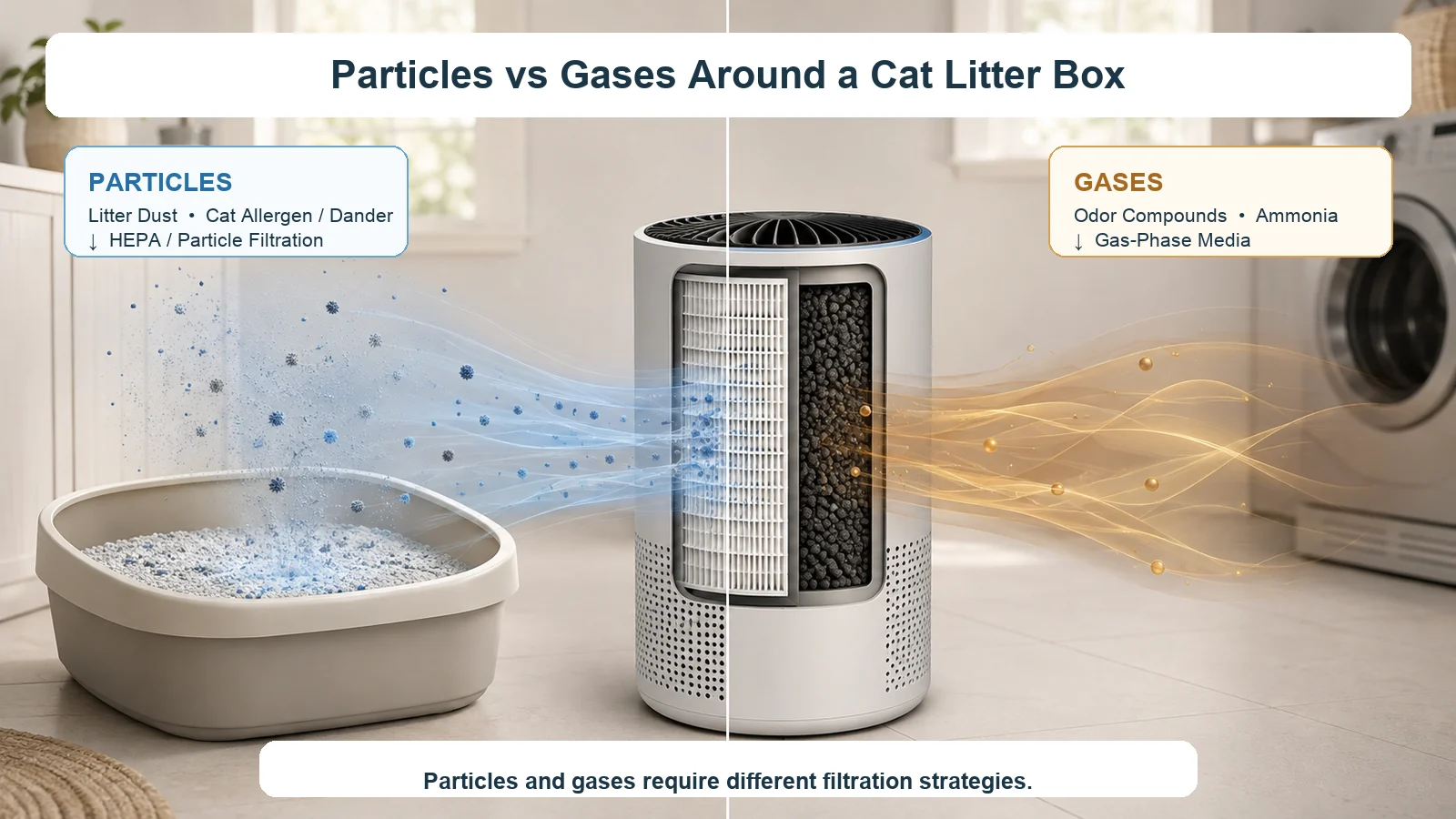
An older government-reported consumer pouring scenario measured breathing-zone respirable particulate matter while 4.54 kg (10 lb) of conventional or “scoopable” litter was poured. The reported 3-minute range was 8.6–141 µg/m³ per kg of litter. This is useful evidence that pouring can create a particle exposure scenario, but it is not a typical-home PM2.5 value, a particle-size range, or evidence about digging, scooping, tracking, or every litter type.
Cat allergen, cat dander, pet hair, and litter dust also should not be treated as interchangeable. For example, evidence about airborne Fel d 1 concerns cat allergen, not mineral or plant-based litter dust. If allergies are also part of the problem, see our cat allergy air purifier guide.
What HEPA Can—and Cannot—Do Around a Litter Box
HEPA and other pleated filters are mechanical filters: air is pulled through the filter and particles are trapped. A technical HEPA requirement can be 99.97% for particulates at 0.3 microns or larger under a specified test context, but that technical reference does not certify every retail product using a HEPA-related label.
For litter dust, the practical question is not only the filter label. A portable cleaner can only filter particles that become airborne and are then drawn through the unit. CADR combines airflow and particle removal, making it more useful for room-level particle sizing than a single-pass filter claim. EPA advises choosing a particle cleaner with a CADR large enough for the room.
What HEPA cannot do is just as important: it is not the mechanism for removing gaseous odor, VOCs, or ammonia. If odor is the priority, look beyond the word “HEPA” to the product’s gas-phase media and to the source itself. Our activated carbon filter guide for pet odors explains what carbon can and cannot do for airborne pet smells.
HEPA vs. Activated Carbon for Cat Litter
What HEPA Targets
Mechanical filtration targets airborne particles. That makes it relevant to the particle side of a litter-box setup, including airborne litter-related dust after it has entered room air. It does not establish odor or ammonia removal.
What Gas-Phase Media Targets
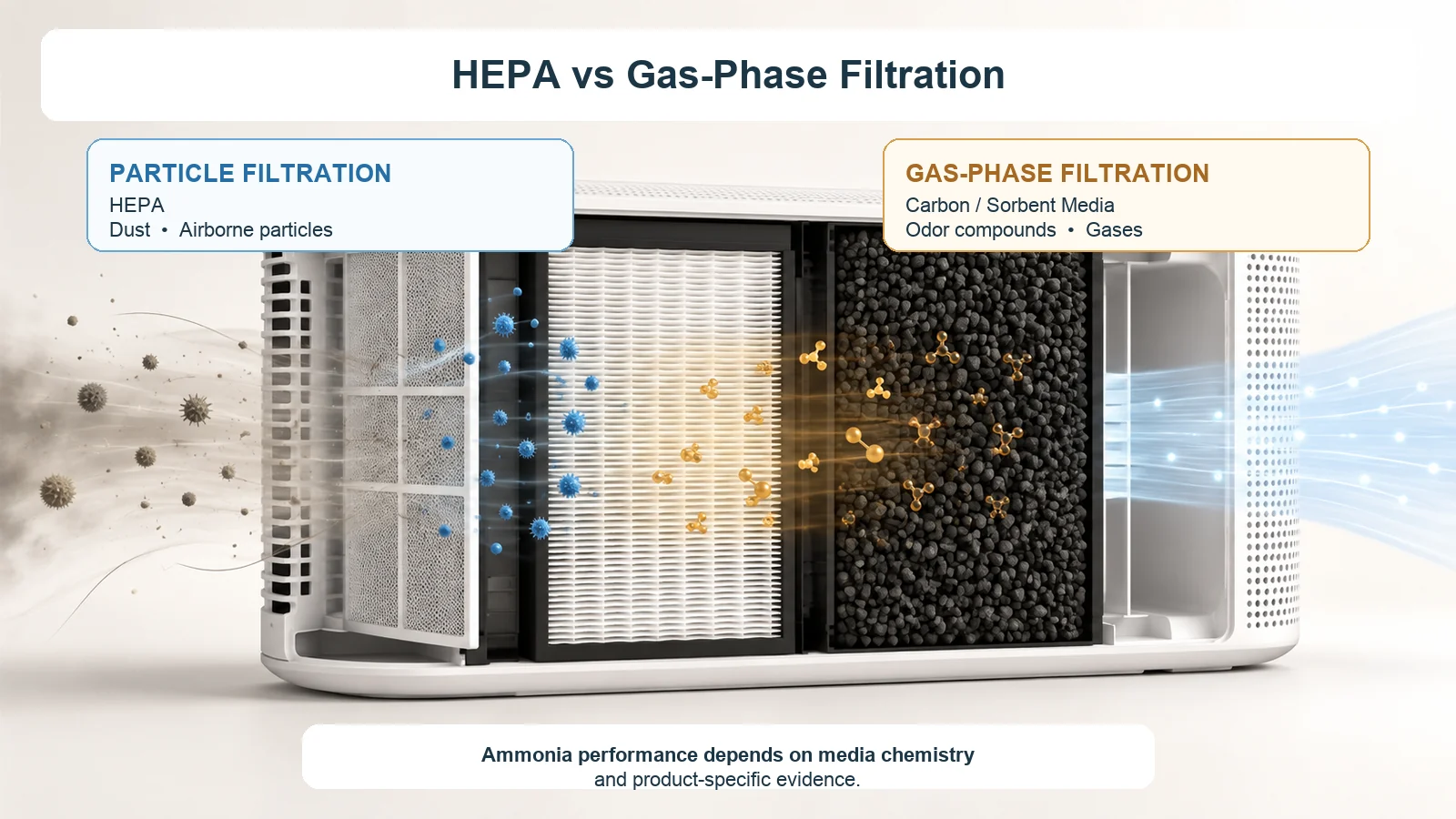
EPA distinguishes gas filtration from particle filtration and advises choosing activated carbon or another filter designed for gases when gas removal is the goal. It also notes that portable-cleaner gas filters do not have a widely used performance rating comparable to CADR.
This is why a high particle CADR does not answer the question, “Will it remove cat litter smell?” It may be useful for airborne particles while offering little evidence about gas performance.
Why Carbon Filters Are Not All the Same
For gas filtration, disclosure matters. EPA notes that activated carbon can be effective for gases when a large amount of material is used, but does not provide a universal minimum carbon weight. Filters also need replacement when dirty or overloaded.
The ammonia boundary is narrower still. A material-level study found limited ammonia retention for unmodified activated carbon in its test context and found that surface chemistry and impregnation affected adsorption. That does not prove the performance, life, or suitability of a specific consumer purifier.
In short, “contains activated carbon” is a starting point for questions—not proof that a purifier removes ammonia effectively.
How We Evaluate Ammonia Claims
The strongest evidence would be an independent, exact-model ammonia performance test. A lower tier is a manufacturer’s pollutant-specific claim for an exact model. Material-level sorbent research can explain why media chemistry may matter, but it cannot validate a retail purifier. Generic carbon presence is the weakest basis for an ammonia conclusion.
One example is IQAir’s current US GCX AM XE page, whose technical configuration and cartridge documentation use the GCX AM name. IQAir documents 22 lb of impregnated activated carbon for ammonia and ammonia compounds. This is a manufacturer-specific, ammonia-targeted configuration claim—not an independent exact-model performance test.
How to Choose an Air Purifier for a Litter Box
Particle Filtration
Look for clear particle-filtration terminology and avoid assuming that every “HEPA-type” description has the same verification. Then check whether the unit has enough published particle-cleaning data for the room.
CADR
CADR is the volume of filtered air delivered for particles. AHAM labels list smoke, dust, and pollen CADRs, and EPA says CADR applies to particles only. Smoke CADR is especially useful when choosing for small-particle cleaning because it represents the smallest of the three CADR test particle categories.
Do not use CADR as an odor, carbon-filter, or ammonia score. Also, do not compare square-foot claims across brands unless their ACH, ceiling-height, and test assumptions are known. For a broader comparison of particle, odor, hair, and dander needs, start with our complete pet air purifier buying guide.
Gas-Phase Media
For an odor-focused purchase, examine what the manufacturer actually discloses: media type, amount, chemistry or treatment where stated, cartridge structure, and replacement information. Missing information is meaningful; it is better recorded as “not disclosed” than filled in with assumptions. When you are ready to compare models that emphasize gas filtration, see our carbon-filter air purifier product picks.
Pre-Filter
A pre-filter can help manage larger visible debris before it reaches later stages; maintenance instructions remain model-specific. In homes where loose cat hair collects around the litter area, look for a pre-filter that is clearly described and practical to maintain. Keep the intake and outlet unobstructed so the unit can move air.
Noise and Runtime
Higher fan speeds and longer run time generally filter more air, while noise can affect whether a unit is used consistently. Use the setting that provides useful particle cleaning at a noise level you can realistically live with. This is a practical operating decision, not a rule that every purifier must run 24/7.
Filter Replacement Cost
Replacement filters are part of the ownership decision. In this research, official snapshots listed a Levoit Core 400S-P original filter at $49.99 and an Austin HealthMate replacement filter at $315; prices can change. Compare the specific replacement filter, its stated interval, and the current price—not only the unit price.
Ozone and Electronic Air Cleaning
If a product includes an ionizer, plasma feature, bipolar device, or similar electronic air-cleaning feature, disclose it and verify the exact model’s documentation. EPA advises avoiding devices that intentionally produce ozone and says not to use ozone generators in occupied spaces.
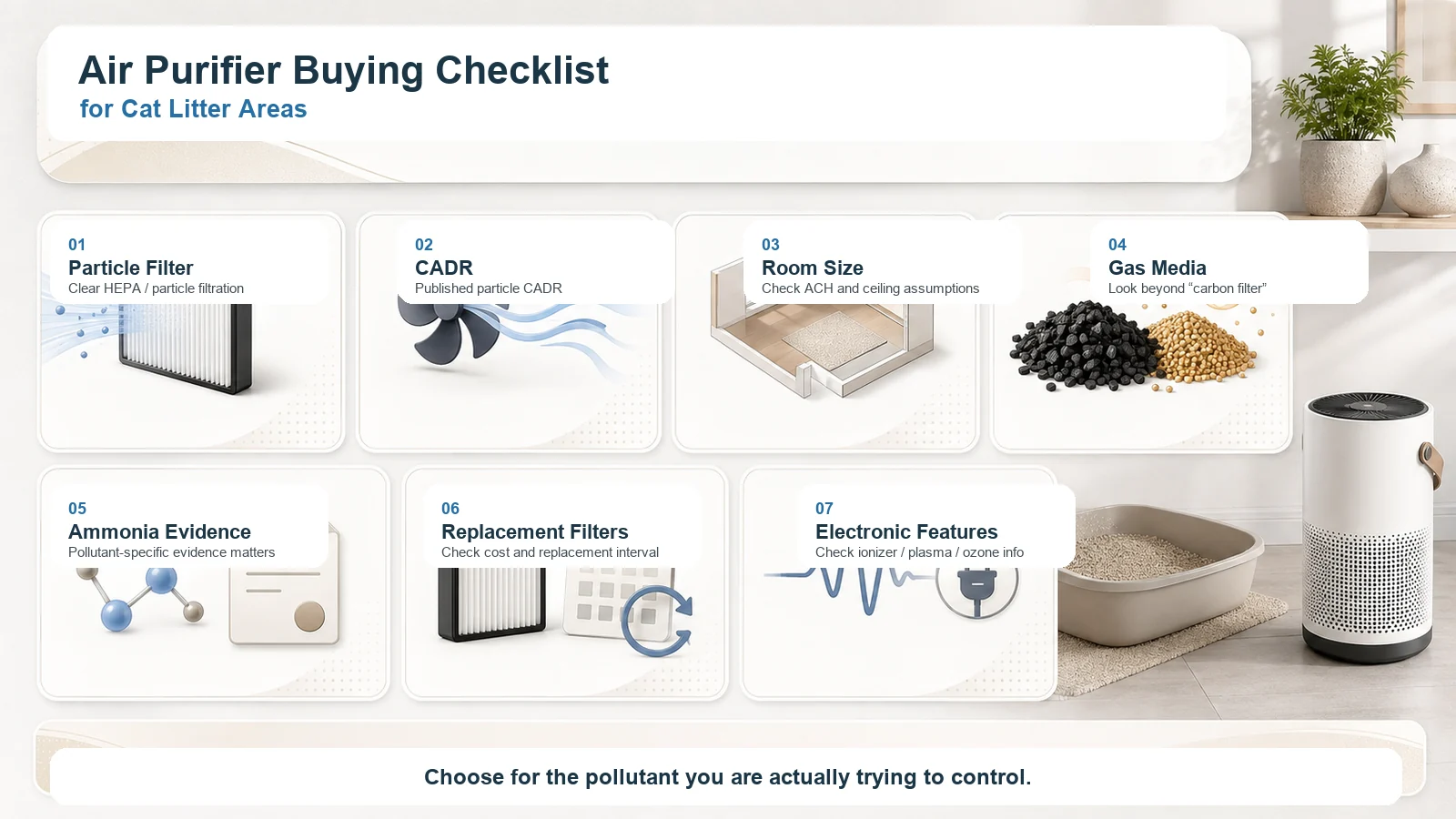
What to Check Before Buying
- Is particle filtration clearly specified?
- Is a particle CADR disclosed, and is its category clear?
- Is the room-size claim tied to a stated ACH and ceiling assumption?
- Is gas-phase media described beyond a generic “carbon filter” label?
- Is media quantity or chemistry disclosed, where gas control matters?
- Is ammonia performance specifically documented, or merely implied?
- What replacement filter is required, and what does it currently cost?
- Is the unit actually available, rather than merely listed on a live page?
- Does it include ionization, plasma, or another electronic air-cleaning feature?
What Size Air Purifier Do You Need?
For particles, EPA’s estimate table uses 65 cfm of CADR per 100 square feet at an 8-foot ceiling through 600 square feet. AHAM’s consumer guidance says smoke CADR should be at least two-thirds of room area, with a larger unit considered for ceilings above 8 feet.
ACH and CADR are related but not identical. For a known particle CADR in cfm, an equivalent particle-cleaning ACH can be estimated as:
CADR × 60 ÷ room volume in cubic feet
For an illustrative 10-by-12-foot room with an 8-foot ceiling, volume is 960 cubic feet. A 4.8-ACH illustration would require about 77 cfm of particle CADR (960 × 4.8 ÷ 60). AHAM says its Verifide suggested room size is based on 4.8 ACH, but this is not a cat-litter-specific requirement.
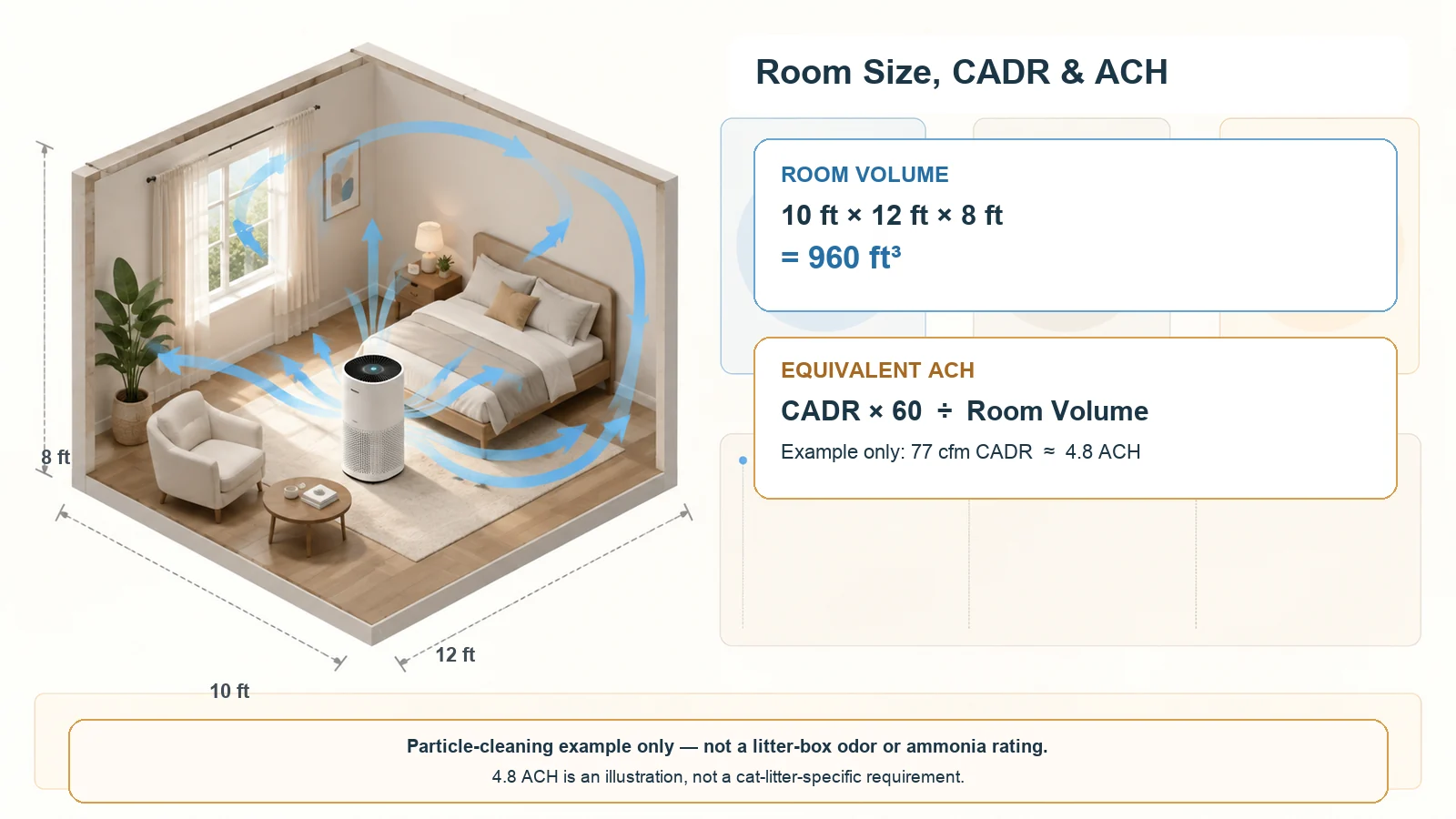
Room shape, open doors, higher ceilings, outdoor-air exchange, deposits, and source strength affect actual conditions. Use the calculation for particle cleaning only; it does not size odor or ammonia control.
Where Should You Put the Air Purifier?
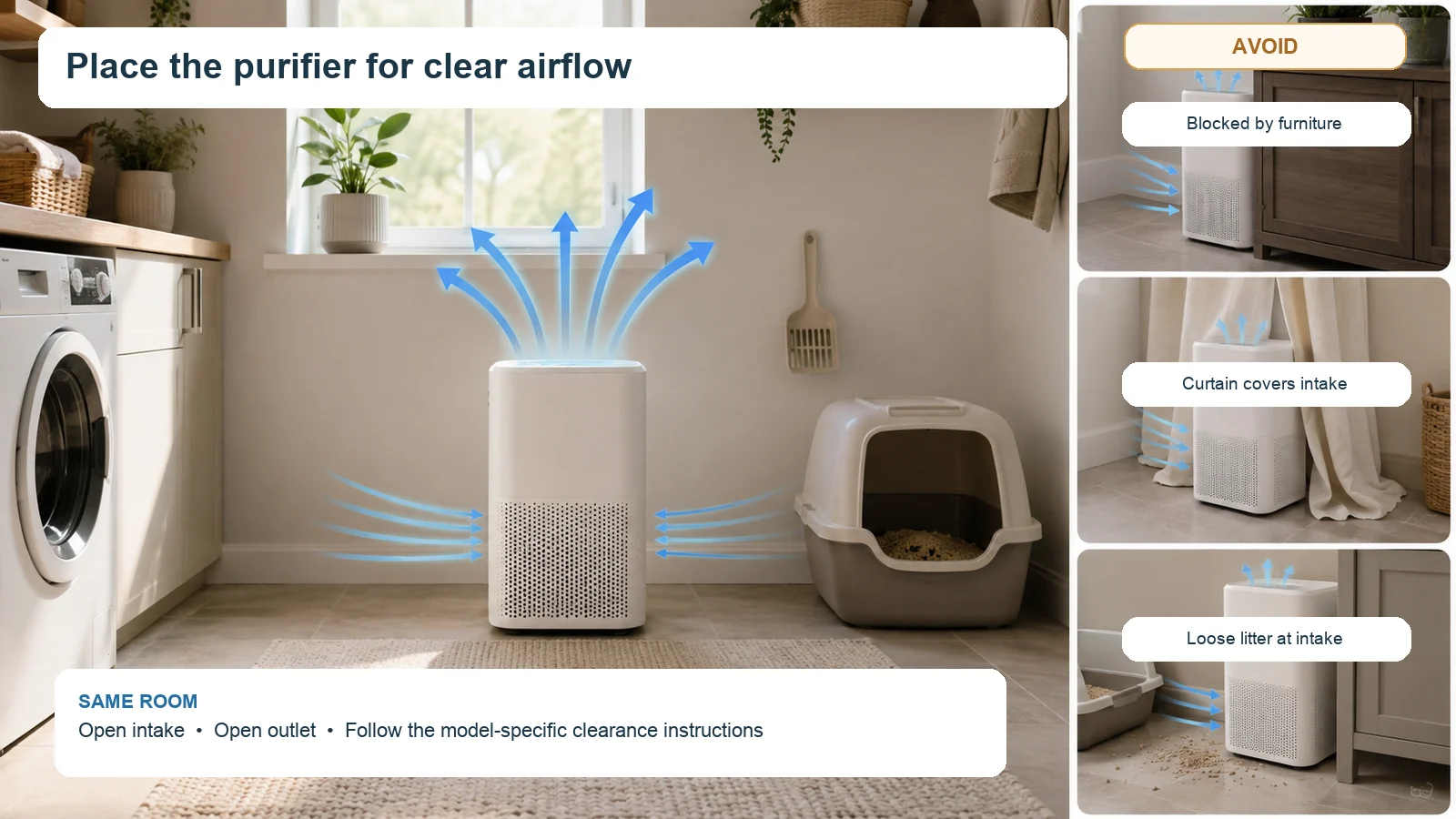
Place the unit in the room where the issue occurs, with its intake and outlet clear of curtains, furniture, and other obstructions. EPA recommends unobstructed airflow; the exact clearance requirement should come from the unit’s manual.
There is no verified universal litter-box-to-purifier distance. Rather than placing a unit at an arbitrary number of feet, give it a clear airflow path, prevent loose litter from directly clogging the intake, and follow the model-specific instructions. Coway’s AP-1512HH manual, for example, specifies its own clearances; those measurements are not a rule for other models.
Reduce Cat Litter Dust and Odor at the Source
Source reduction and ventilation with clean outdoor air are EPA’s most effective indoor-air measures; filtration is supplemental. For clumping litter, Cornell recommends removing feces and clumps daily and changing litter often enough to keep it dry and clean.
Practical source-control priorities include prompt waste removal, routine surrounding cleanup, sensible litter handling, and maintaining the purifier’s filters. A litter marketed as low-dust may be worth considering, but the evidence reviewed here did not establish a universal independent percentage reduction in household airborne particles across litter types.
Product Examples: What the Specifications Actually Tell Us
These are examples of documentation differences, not rankings or “best” picks.
Availability and pricing note: Market availability and replacement-filter prices fluctuate. The comparison was last audited in September 2026; recheck current price, stock, and exact model configuration before buying.
| Product | Particle filtration / particle data | Gas media | Gas-media amount disclosed? | Ammonia-specific evidence | Availability note |
|---|---|---|---|---|---|
| Coway AP-1512HH | Official page lists a HEPA filter; current pack does not use a verified particle CADR from the reviewed product table | Deodorization filter | Not disclosed | No specific ammonia test data in the reviewed documentation | Confirm current availability before buying |
| Levoit Core 400S-P | 3-stage filtration; 231 cfm CADR, category not stated | Activated-carbon filter | Not disclosed | No specific ammonia test data in the reviewed documentation | Confirm current availability before buying |
| Austin HealthMate | Manufacturer lists multi-stage filtration including HEPA; CADR not disclosed | Activated carbon plus mineral-based filtration | 15 lb | No specific ammonia test data in the reviewed documentation | Verify current stock with the seller |
| IQAir GCX MultiGas | H11 prefilter and post-filter sleeve; CADR not disclosed | Granular activated carbon plus impregnated alumina | 22 lb | No specific ammonia test data for this configuration in the reviewed documentation | Purchase status was not established in the reviewed material |
| IQAir GCX AM / current US GCX AM XE page | HyperHEPA terminology, H11 prefilter, and post-filter sleeves; CADR not disclosed | Impregnated activated carbon (AC/4-AM) | 22 lb | Manufacturer ammonia claim; no independent exact-model test data in the reviewed documentation | Displayed sold out at last review; recheck before buying |
| AllerAir AirMedic Pro 6 Ultra | Super HEPA manufacturer claim; published 560 CFM is airflow, not CADR | Exec or Vocarb carbon canister | Exec 31–33 lb; Vocarb 32–34 lb | No specific ammonia test data in the reviewed documentation | Verify current stock with the seller |

Coway AP-1512HH
$229.99

Levoit Core 400S-P
$189.99

IQAir GCX MultiGas
$1599.99
The table shows why a consumer should separate particle-cleaning information from gas-media disclosure. Levoit provides a published CADR, while the larger-media examples disclose more about their gas filtration but do not provide a comparable CADR. Media weights are disclosure facts, not a performance ranking.
Here is how to use those differences without turning them into a “best” list:
- Particle-first comparison: For dust, prioritize published CADR and a stated room/ACH basis. Levoit lists 231 cfm, but does not disclose carbon quantity.
- Gas-media-transparency comparison: Austin, IQAir GCX MultiGas, and AllerAir publish media quantities or construction details. That makes their gas stage easier to inspect, not a proportional odor or ammonia score.
- Ammonia-specific documentation: IQAir documents the GCX AM configuration for ammonia and ammonia compounds, but without an independent exact-model test; verify current unit availability before buying.
The IQAir GCX AM configuration is stronger evidence of manufacturer design intent for ammonia than generic carbon copy. It still does not equal independent proof of ammonia removal in a litter room. The Winix 5500-2 is omitted as a current buying example because only filter/legacy support was verified and new-unit status remained unclear.
What an Air Purifier Cannot Fix
An air purifier cannot replace litter-box hygiene, waste removal, cleaning, ventilation where appropriate, or filter maintenance. It cannot guarantee that every odor disappears, that ammonia is eliminated, or that every airborne exposure is removed. A purifier is one layer of an indoor-air approach, not a substitute for managing the source.
Frequently Asked Questions
Do air purifiers work for cat litter?
They can help with airborne particles when sized for the room. Odor and ammonia are gases, so their control depends on suitable gas-phase media and source control, not HEPA alone.
What is the best air purifier for cat litter dust?
There is no evidence-based single winner in this research. Prioritize clearly specified particle filtration and a particle CADR appropriate for the room; avoid using odor claims as a substitute for particle-cleaning data.
Do air purifiers get rid of cat litter box smell?
They may supplement odor control when they have appropriate gas-phase media, but no portable-cleaner gas rating establishes a universal result. Prompt waste removal, cleaning, and ventilation remain central.
Does HEPA remove ammonia?
No. HEPA is particle filtration, while ammonia is a gas. Do not assume that a generic carbon layer proves ammonia removal either.
Should I put an air purifier next to the litter box?
Use the same room when practical, but prioritize unobstructed intake and outlet clearance plus the manufacturer’s instructions. No universal litter-box distance was identified.
How do I stop my house from smelling like cat litter?
Start with source control: remove waste promptly, keep the box and surrounding area clean, and use ventilation where appropriate. If adding a purifier, assess gas-phase media separately from particle filtration.
Bottom Line
For cat litter dust, prioritize a particle filter and enough particle CADR for the room. For litter-box smell, look beyond HEPA to what the manufacturer actually discloses about gas-phase media, then keep source control at the center of the plan.
A larger carbon-media disclosure may be useful buying information, but it is not an ammonia-removal score. If ammonia is the concern, do not turn generic carbon into proof; even an ammonia-targeted manufacturer configuration is not the same as independent exact-model performance evidence.