Best Air Purifier for Litter Box Smell: Top Picks for Cat Odor
If your home smells like cat urine, ammonia, or dirty litter even after cleaning the litter box regularly, you are not alone. Litter box odor is one of the most common problems for cat owners, especially in apartments, bedrooms, bathrooms, laundry rooms, and homes with multiple cats.
Many people try scented sprays, air fresheners, or heavily scented litter to hide the smell. However, these solutions usually only cover odors temporarily and may create stronger fragrances that some cats dislike. A better approach is using an air purifier designed to reduce airborne odor molecules, litter dust, and pet allergens.
However, choosing the best air purifier for litter box smell is not as simple as buying any HEPA air purifier. HEPA filters are excellent for capturing cat dander, litter dust, and pet hair, but odor removal requires additional filtration. For cat urine smell and ammonia-like odors, the most important factors are activated carbon quality, airflow, room coverage, and proper placement.
In this guide, we will explain what actually works for litter box odor, how to choose the right purifier, and the best models for different cat households. If you are comparing litter box odor with broader pet smell problems, start with our pet odor air purifier guide.
Quick Answer: What Is the Best Air Purifier for Litter Box Smell?
The best air purifier for litter box smell should include several important features:
- True HEPA filtration to capture litter dust, cat hair, and dander.
- Activated carbon or specialized odor filters to reduce pet odors, VOCs, and ammonia-like smells.
- Strong CADR performance to circulate and clean room air quickly.
- Low operating noise if the litter box is near bedrooms or living areas.
- Affordable replacement filters because odor filters can wear out faster near litter boxes.
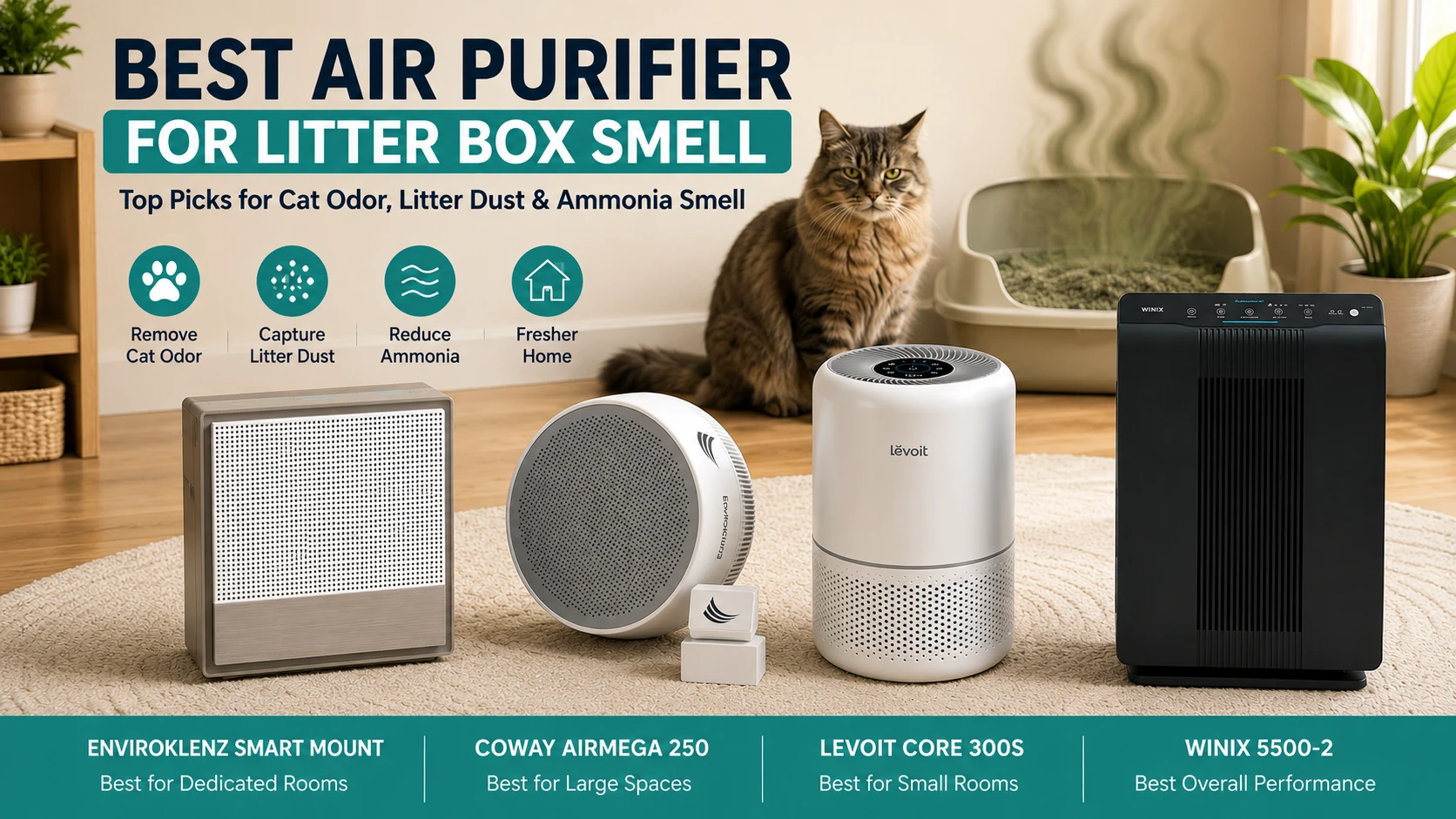
For most cat owners, the Winix 5500-2 is one of the strongest value choices because it combines a washable pre-filter, True HEPA filtration, and an AOC carbon filter designed for household odors from pets, cooking, and smoke.
For smaller rooms, the Levoit Core 300S is a compact smart option that works well for bedrooms, apartments, and small litter areas.
For larger spaces and multi-cat homes, the Coway Airmega 250 provides stronger airflow and higher CADR performance.
For a dedicated litter room, laundry room, or multi-cat area, the EnviroKlenz SMART Mount offers a premium wall-mounted solution using specialized odor-control technology.
An air purifier can help reduce airborne litter box smell, but it cannot replace regular scooping, cleaning the litter box, replacing old litter, improving ventilation, or using enough litter boxes. For a broader buying shortlist across all pet homes, compare our best air purifiers for pets guide.
Best Air Purifiers for Litter Box Smell: Quick Comparison
| Best For | Air Purifier | Why It Works |
|---|---|---|
| Best Overall | Winix 5500-2 | Strong airflow, True HEPA filtration, and pellet-based activated carbon filter for pet odors. |
| Best Small Room | Levoit Core 300S | Compact design, quiet operation, smart control, suitable for small litter areas. |
| Best Large Room | Coway Airmega 250 | Higher CADR and stronger room coverage for larger homes and multi-cat households. |
| Best Dedicated Litter Room | EnviroKlenz SMART Mount | Wall-mounted design with specialized odor-control technology. |
Do Air Purifiers Help With Litter Box Smell?
Yes, air purifiers can help reduce litter box smell, but the results depend heavily on the type of filter inside the machine.
Cat litter odor usually comes from a combination of:
- Urine odor and ammonia-like gases
- Feces odor
- Dust from cat litter
- Pet dander and hair
- Poor air circulation
An air purifier works by pulling contaminated air through filters. The HEPA filter captures particles such as litter dust and dander, while activated carbon or specialized odor filters help trap odor molecules.
However, an air purifier cannot remove the source of the smell. If waste remains in the litter box too long, the odor will continue. The best results usually come from combining:
- Daily scooping
- Good quality odor-control litter
- Proper ventilation
- A suitable air purifier
For multi-cat homes, an air purifier becomes even more useful because odor builds up faster and spreads more easily.
HEPA vs Activated Carbon: What Matters for Cat Odor?
A common mistake is choosing an air purifier only because it has a HEPA filter. While HEPA is important, it is not the main solution for litter box smell.
HEPA Filters: Best for Dust and Allergens
HEPA filters are designed to capture small airborne particles, including:
- Cat dander
- Fine litter dust
- Pollen
- Dust
- Pet hair particles
This makes HEPA filtration valuable for homes with cats, especially if someone suffers from allergies. If cat dander is also a problem, compare more options in our cat allergy air purifier guide.
However, odor molecules are gases, not particles. HEPA filters alone cannot effectively remove ammonia smell or strong litter odors.
Activated Carbon Filters: Best for Odor Removal
Activated carbon is the key filter material for litter box smell.
Carbon works by adsorbing odor molecules and VOCs as air passes through the filter. For cat owners, this helps reduce:
- Urine smell
- Pet odor
- Dirty litter smell
- Household odors
The amount and type of carbon matter. Many inexpensive air purifiers only use a thin carbon-coated sheet, which provides limited odor reduction.
Better odor-control models use more substantial carbon filters or pellet carbon designs. For a deeper explanation of carbon media, see our carbon filter guide for pet odor.
For example, the Winix 5500-2 uses an AOC carbon filter with activated carbon pellets, providing stronger odor adsorption compared with basic carbon fabric filters.
Specialized Odor Filters
Some premium air purifiers use alternative odor-control technology instead of relying only on activated carbon.
The EnviroKlenz SMART Mount uses specialized mineral-based filtration technology designed for chemical odors and VOCs. Instead of only trapping odor molecules like traditional carbon filters, it uses a different approach to neutralizing unwanted smells.
This type of filtration can be useful for:
- Strong pet odors
- Multi-cat homes
- Dedicated litter rooms
- Areas where traditional carbon filters become saturated quickly
How to Choose an Air Purifier for Litter Box Smell
Before buying an air purifier for cat litter odor, focus on the features that directly affect smell reduction rather than only looking at the advertised room size.
1. Carbon Filter Quality
For litter box odor, the quality and amount of odor-control media are extremely important.
Look for:
- Activated carbon filters
- Pellet carbon filters
- Pet odor-specific filter options
- Replaceable odor filters
Avoid relying only on thin carbon-coated fabric filters, which may help with light odors but usually struggle with strong cat urine or ammonia-like smells.
2. CADR and Air Changes
Air purifier coverage numbers can sometimes be misleading. A purifier may advertise coverage for a very large room, but that number may only represent one air change per hour.
For litter box odor control, faster air circulation is usually more important.
Pay attention to:
- CADR (Clean Air Delivery Rate): How quickly the purifier can clean air.
- ACH (Air Changes Per Hour): How often the purifier can replace the air in a room.
A smaller purifier with strong airflow may work better than a larger purifier that only cleans the air slowly.
3. Filter Replacement Cost
Litter box odor can use up carbon filters faster than normal household dust because the filter continuously absorbs odor molecules.
Before purchasing, check:
- Replacement filter price
- Filter availability
- Recommended replacement schedule
A cheaper air purifier may become expensive if replacement filters are difficult to find or cost too much.
Best Air Purifiers for Litter Box Smell
Best Overall: Winix 5500-2
Winix 5500-2 Air Purifier
- True HEPA filtration
- Washable carbon filter for odors
- Smart auto and sleep modes
- Ideal for medium-sized rooms

The Winix 5500-2 is one of the best choices for cat litter odor because it combines strong airflow, True HEPA filtration, and a better-than-average carbon filter. For model-specific details, read our Winix 5500-2 air purifier review.
Its filtration system includes:
- Washable pre-filter
- AOC activated carbon filter
- True HEPA filter
The washable pre-filter captures larger particles such as cat hair and litter dust before they reach the main filters. The True HEPA filter removes airborne particles, while the activated carbon filter focuses on odors.
The biggest advantage for litter box smell is the AOC carbon filter. Unlike many budget air purifiers that only use carbon-coated fabric, the Winix 5500-2 uses activated carbon pellets, providing better odor adsorption for:
- Cat urine smell
- Pet odors
- Household VOCs
- Cooking odors
The Winix 5500-2 is a strong option for:
- Medium bedrooms
- Apartments
- Cat rooms
- Multi-cat homes
Another advantage is replacement filter availability. Since litter box odors can shorten carbon filter life, affordable replacement options make the Winix easier to maintain over time.
Pros:
- Strong odor filtration
- True HEPA filter
- Good value
- Washable pre-filter
- Affordable replacement filters
Cons:
- Larger than compact bedroom models
- PlasmaWave feature may not appeal to every pet owner
- Not ideal for very small spaces
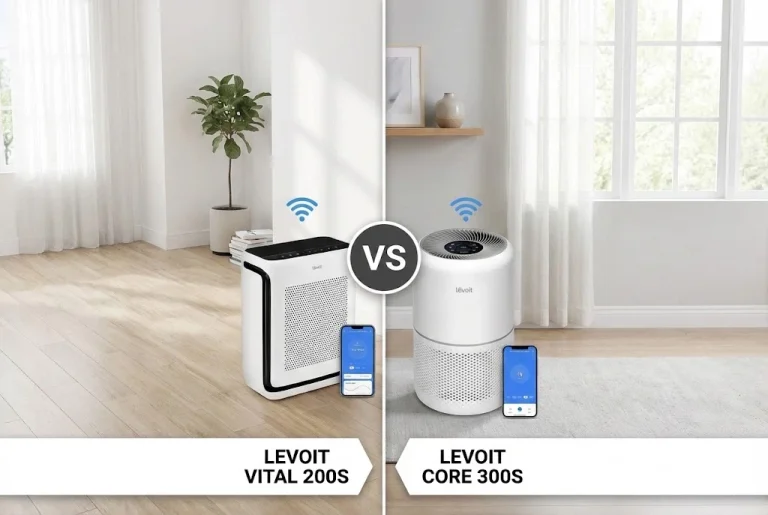
Best Small Room Option: Levoit Core 300S
LEVOIT Air Purifiers Core 300S
- AHAM-verified performance
- Quiet 22 dB sleep mode
- Smart app and voice control
- Activated carbon for odors

The Levoit Core 300S is a compact smart air purifier suitable for smaller litter box areas. If you prefer Levoit, compare more options in our Levoit air purifiers for pets guide.
It works well for:
- Bedrooms
- Small apartments
- Bathrooms
- Home offices
Key features include:
- 141 CFM CADR
- Quiet operation around 22 dB in sleep mode
- Smart app control
- Pet and odor filter options
The Core 300S is not designed for large open spaces, but it is a practical choice when the litter box is located in a small room.
Its compact size allows flexible placement, and the quiet operation makes it suitable near sleeping areas.
For litter odor control, selecting the correct replacement filter is important. Pet and odor-focused filters are more suitable than basic particle filters.
Pros:
- Compact design
- Quiet operation
- Smart control
- Good for small rooms
Cons:
- Limited carbon capacity compared with larger models
- Not the best choice for large multi-cat homes
Best Large Room Option: Coway Airmega 250
Coway Airmega 250
- Large-room coverage
- HEPA and carbon filtration
- Smart air quality monitoring
- Rapid cleaning mode

The Coway Airmega 250 is designed for larger rooms and homes where litter odor spreads beyond the immediate area.
Its filtration system includes:
- Washable pre-filter
- Activated carbon filter
- HEPA filter
Important specifications:
| Feature | Specification |
|---|---|
| CADR | 249 Smoke / 261 Dust / 230 Pollen |
| Coverage | 465 sq ft at 4 air changes per hour |
| Filter | Max2 Activated Carbon + HEPA |
| Filter Life | About 1 year |
The Airmega 250 is a better option for:
- Open apartments
- Living rooms
- Multi-cat homes
- Large litter areas
Its Smart Mode automatically adjusts fan speed based on air quality, while Rapid Mode helps clean the room faster after cleaning the litter box or changing litter.
Pros:
- Strong airflow
- Large room coverage
- Smart operation
- Long filter life
Cons:
- Larger footprint
- Replacement filters may cost more
- Higher power consumption than small models
Best Dedicated Litter Room Option: EnviroKlenz SMART Mount
EnviroKlenz SMART Mount
- Wall or ceiling mounted
- H13 HEPA with FAST-ACT technology
- Real-time air quality monitoring
- Automatic smart response

The EnviroKlenz SMART Mount is designed for cat owners who want a more permanent air-cleaning solution in a litter room, laundry room, utility room, or multi-cat area.
Unlike traditional air purifiers that mainly rely on activated carbon, EnviroKlenz uses specialized mineral-based odor filtration technology designed for chemical odors and VOCs. This gives it a different approach from standard carbon-filter purifiers and may help in situations where regular carbon filters become saturated quickly.
The wall or ceiling mounting design also saves floor space and prevents cats from knocking over the purifier.
It is especially suitable for:
- Dedicated litter rooms
- Multi-cat households
- Laundry rooms
- Utility rooms
- Strong odor situations
Pros:
- Specialized odor-control technology
- Wall-mounted design saves space
- Useful for strong pet odors
- Includes air quality monitoring features
Cons:
- More expensive than regular portable purifiers
- Requires installation
- Overkill for small one-cat homes
Where Should You Place an Air Purifier Near a Litter Box?
Placement can greatly affect how well an air purifier works. Even the best air purifier for litter box smell will perform poorly if it cannot access the contaminated air.
For the best results:
- Place the purifier a few feet away from the litter box.
- Keep the air intake facing the general litter area.
- Leave enough space around the purifier for airflow.
- Do not place it inside a closed cabinet.
- Do not block your cat’s access to the litter box.
If your litter box is inside a bathroom, closet, or laundry room, make sure air can circulate. Closed spaces trap odor quickly, and an air purifier needs continuous airflow to remove smells effectively.
For small apartments, a compact purifier like the Levoit Core 300S can work well when the litter box is located in a small room. For larger open areas, stronger models like the Winix 5500-2 or Coway Airmega 250 are better because they move more air.
How to Reduce Litter Box Smell Beyond an Air Purifier
An air purifier should be part of a complete litter odor control strategy. If the litter box itself produces strong odors, even the best purifier will only provide limited results.
Scoop the Litter Box Regularly
Remove waste at least once a day. In multi-cat homes, you may need to scoop twice daily because waste builds up faster and creates stronger odors.
Choose Better Cat Litter
Low-dust clumping litter with good odor control can significantly reduce smells. Strongly scented litter may hide odors temporarily, but some cats dislike heavy fragrances and may avoid using the litter box.
Clean or Replace Old Litter Boxes
Plastic litter boxes can absorb urine odors over time. If cleaning no longer removes the smell, replacing the box may improve odor control.
Improve Ventilation
A closed room allows odor molecules to accumulate. Air movement and fresh air exchange help an air purifier work more effectively.
Replace Filters on Time
Carbon filters absorb odor molecules continuously. When the filter becomes saturated, the purifier may still remove dust but become less effective at reducing smell.
For litter box areas, check the odor filter condition regularly and replace it according to the manufacturer’s recommendation.
Final Recommendation
Choosing the best air purifier for litter box smell depends on your home size, number of cats, and odor level.
- Best Overall: Winix 5500-2 — The best balance of odor control, airflow, HEPA filtration, and replacement filter cost.
- Best Small Room: Levoit Core 300S — A quiet and compact option for bedrooms, apartments, and small litter areas.
- Best Large Room: Coway Airmega 250 — Better for open spaces and multi-cat homes that need stronger airflow.
- Best Dedicated Litter Room: EnviroKlenz SMART Mount — A premium solution for strong odors and permanent installation.
The most important thing to remember is that litter box odor is mainly a gas problem, not just a particle problem. A good air purifier needs strong airflow and effective odor filtration, especially activated carbon or specialized odor-control media.
Combining the right purifier with regular cleaning, good litter, and proper ventilation will provide the best results for keeping your home fresh and comfortable for both you and your cat.
FAQ
Do air purifiers remove litter box smell?
Yes. Air purifiers with activated carbon or specialized odor filters can reduce airborne litter box smell. However, they work best when combined with regular scooping, cleaning, and proper ventilation.
Is HEPA enough for cat litter odor?
No. HEPA filters are excellent for removing litter dust, cat dander, and airborne particles, but they do not effectively remove odor gases. Activated carbon is more important for smell control.
What is the best filter for litter box smell?
Activated carbon is one of the most effective filter materials for litter box odor because it can adsorb odor molecules and VOCs. Specialized odor-control filters, such as mineral-based filtration, may also help with stronger smells.
Can an air purifier remove ammonia smell from cat litter?
An air purifier can reduce airborne ammonia-related odors when it has a strong odor-control filter. However, it cannot replace cleaning the litter box because ammonia buildup usually comes from waste that needs to be removed.
Should I put an air purifier right next to the litter box?
Place the purifier near the litter box, but leave enough space for airflow. Avoid putting it directly against a wall, inside a cabinet, or where it blocks your cat’s access.
Why does my litter box still smell after using an air purifier?
If the smell remains, the purifier may be too small for the room, the carbon filter may be saturated, ventilation may be poor, or the litter box may need more frequent cleaning.
Are ionizers safe around cats?
Many cat owners prefer avoiding ozone-producing devices. A HEPA plus activated carbon air purifier is usually the safer choice for everyday litter box odor control. If a purifier includes an ionizer, choose a model where the feature can be turned off.