Best Winix Air Purifier for Pets: Dander, Hair & Odor Guide
If you are looking for a Winix air purifier for pets, the best choice depends on what problem you are trying to solve. Pet owners usually care about three different issues: pet dander, pet hair, and pet odors. These problems are related, but they are not the same. Pet dander is a fine airborne allergen that a HEPA filter can help capture. Pet hair is usually heavier and often settles on floors, sofas, and bedding before it reaches the air purifier. Pet odors, such as dog smell, litter box odor, smoke, and cooking smells, require a good carbon filter.
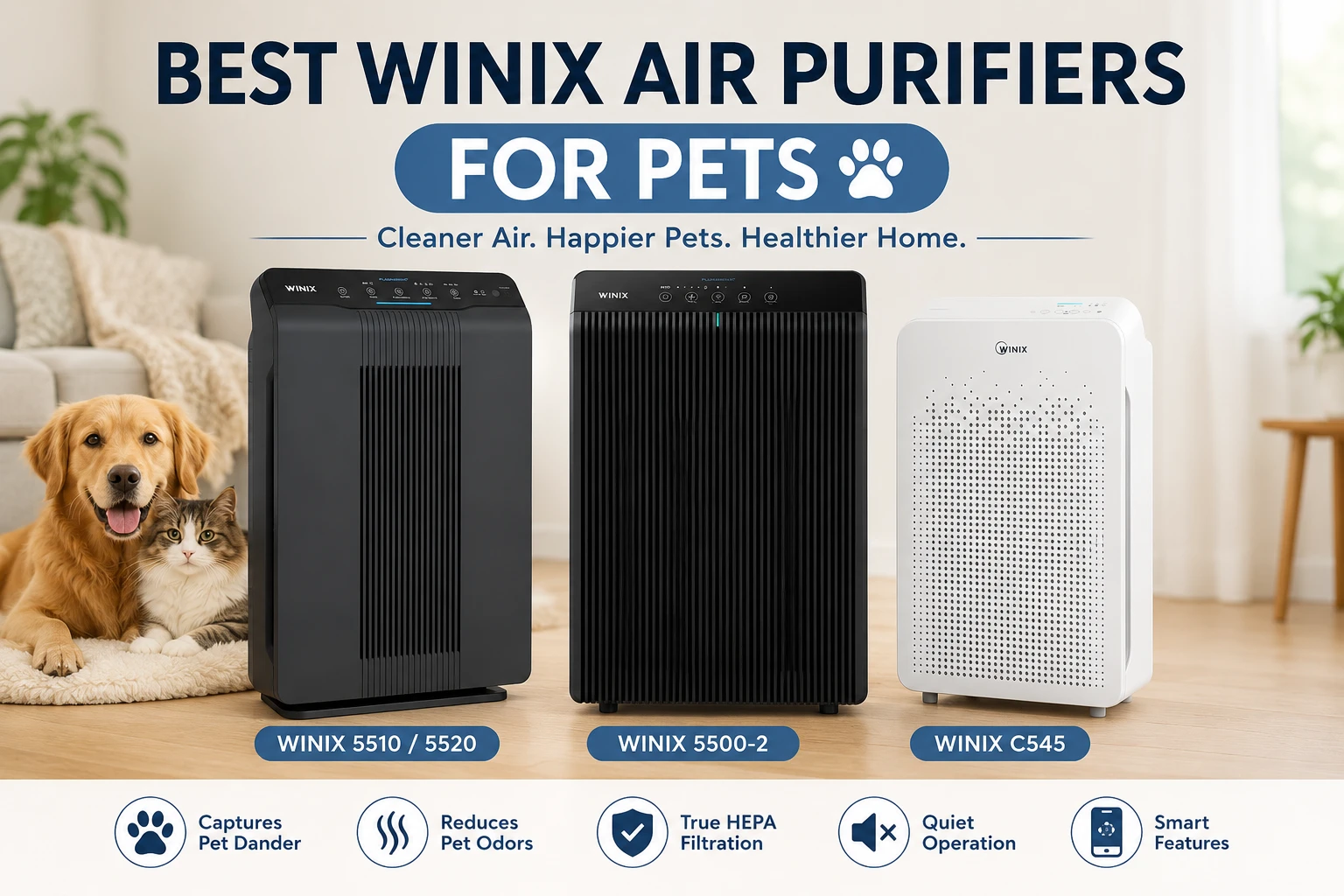
Among the current Winix lineup, the most practical choices for pet homes are the Winix 5510 / 5520, Winix 5500-2, and Winix C545. The 5510 and 5520 are newer-generation models with app support and stronger room coverage claims. The 5500-2 is the older classic model with a strong reputation, a washable AOC carbon filter, and excellent long-term value. The C545 is a quieter, more affordable smart option that works well for bedrooms, small living rooms, and pet owners who want Wi-Fi control.
Below is a practical guide to choosing the best Winix air purifier for pets. If you are still comparing brands beyond Winix, start with our full guide to the best air purifiers for pets.
Quick Picks: Best Winix Air Purifiers for Pet Homes
| Best For | Recommended Model | Why It Works for Pet Owners |
|---|---|---|
| Best overall for most pet homes | Winix 5510 / 5520 | Newer design, app support, True HEPA, strong deodorization carbon filter, good for dander and odors |
| Best classic value | Winix 5500-2 | Excellent reputation, strong CADR, washable AOC carbon filter, lower filter cost, good for pet dander and odor |
| Best bedroom option | Winix C545 | Quiet on low and sleep mode, smart features, suitable for bedrooms and smaller living spaces |
| Best for odor-focused buyers | Winix 5500-2 or 5510 | Separate carbon filtration helps with pet smell, cooking odor, and smoke |
| Best for smart control | Winix 5510 or C545 | App support, auto mode, air quality indicator, and smart sensor features |
What Pet Owners Actually Need From an Air Purifier
A good air purifier for pets should not just “move air.” It should help with the specific particles and smells that pet homes deal with every day.
Pet dander is one of the main reasons people buy air purifiers. It is made of tiny skin flakes and allergen-carrying particles from cats, dogs, and other animals. Because dander can stay airborne, a True HEPA filter is useful. Winix models like the 5500-2, 5510, and C545 use HEPA filtration to capture fine particles such as dust, pollen, smoke particles, and pet dander.
Pet hair is different. Some pet hair can become airborne, especially fine fur or hair stirred up by movement, but much of it falls quickly onto surfaces. A Winix air purifier can help catch some airborne hair and larger particles through the pre-filter, but it will not replace vacuuming, brushing your pets, or washing pet bedding.
Pet odors require carbon filtration. HEPA filters are mainly for particles, not smells. If your main problem is dog odor, litter box smell, smoke, or cooking odor mixed with pet smell, you should pay close attention to the carbon filter design. This is one reason the Winix 5500-2 remains popular: it uses a separate washable AOC carbon filter made with activated carbon granules, which is more useful than a thin carbon sheet in many budget purifiers.
Winix 5510 / 5520: Best Overall for Most Pet Homes
Winix 5520
- Best for most pet homes
- Strong odor control
- Good for allergies
- Easy daily operation
- Quiet for bedrooms
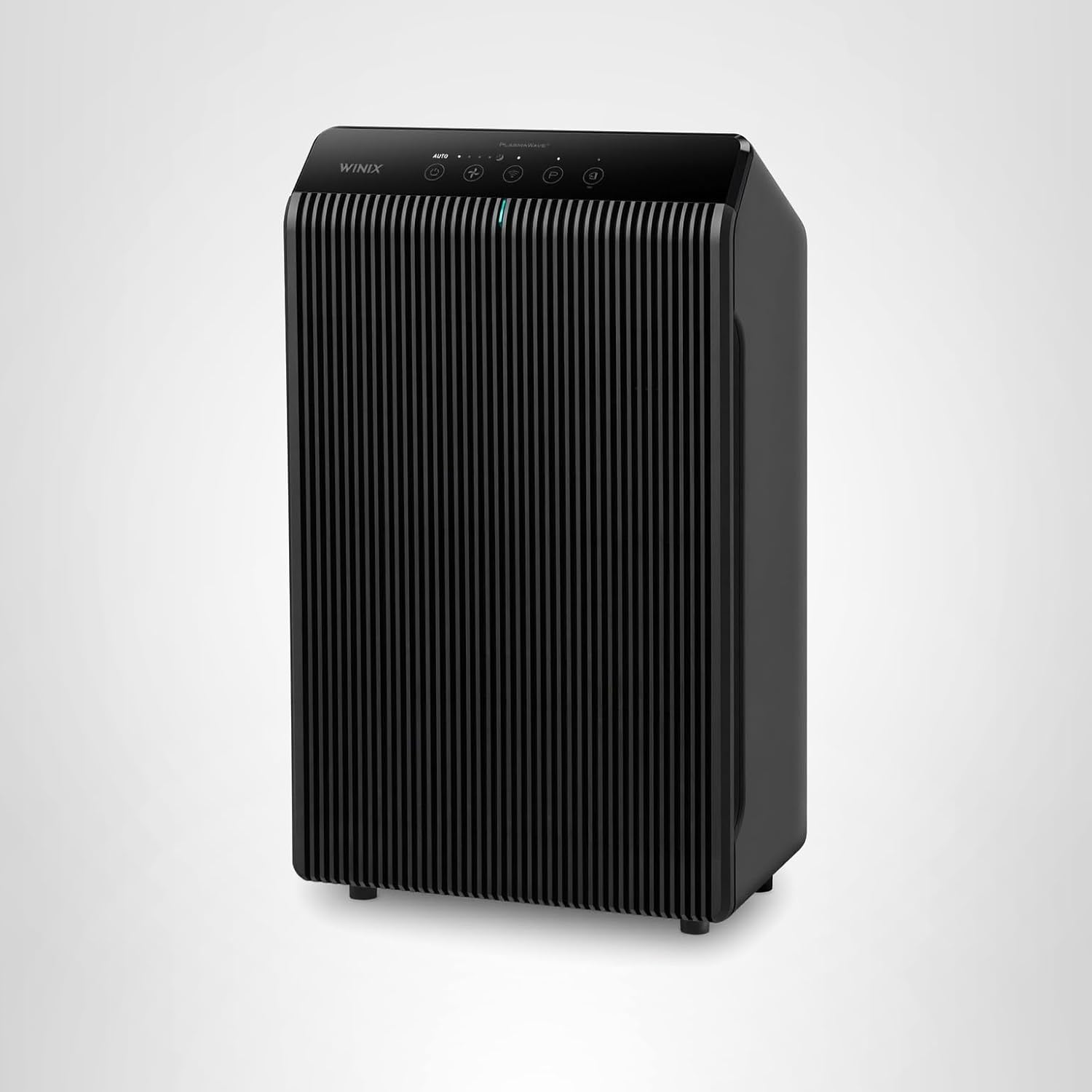
The Winix 5510 and Winix 5520 are newer-generation models that are especially attractive for pet owners who want strong filtration, a modern design, and app support. The 5510 is described as the new generation of the 5500-2, with Winix Smart App compatibility, True HEPA filtration, a high deodorization carbon filter, washable fine mesh pre-filter, auto mode, air quality indicator, and smart sensors.
The 5510 is AHAM verified at 392 square feet, and its listing also says it can clean larger spaces at lower air-change rates, such as up to about 1,881 square feet in one hour. This point is important. For pet homes, you should not only look at the largest advertised room size. A purifier may technically move air through a large room once per hour, but pet owners usually benefit more from multiple air changes per hour in the room where pets spend the most time.
For pet dander, the 5510 / 5520 is a strong choice because it uses True HEPA filtration. For pet odors, the high deodorization carbon filter is useful for everyday dog smell, cooking odor, smoke, and general household odors. For pet hair, the washable fine mesh pre-filter acts as the first stage and helps catch larger airborne particles before they reach the main filter.
The 5510 also has smart features that pet owners may appreciate. Auto mode can adjust fan speed based on detected air quality. The light sensor can switch the unit into sleep mode when the room is dark. App support makes it easier to control the purifier remotely, which is useful if the unit is placed in a pet room, bedroom, or living area.
The main limitation is that the 5510 is not necessarily a huge performance leap over the older 5500-2. Review testing material you provided suggests the 5510 performed similarly to the 5500-2 in particle removal tests. It is more modern and smarter, but not always dramatically better in raw filtration. Also, because it is newer, third-party replacement filter options may be more limited than for the 5500-2.
Best for: pet owners who want a newer Winix model, app control, strong HEPA filtration, carbon odor control, and a modern large-room option.
Winix 5500-2: Best Classic Winix Air Purifier for Pet Dander and Odors
Winix 5500-2
- Great for pet dander
- Strong odor control
- Washable carbon filter
- Auto mode
- Quiet sleep mode
- Good for medium rooms

The Winix 5500-2 is probably the safest classic recommendation for many pet homes. For a deeper model-specific breakdown, read our Winix 5500-2 air purifier review. It has been around for years, has a very large number of customer reviews, and is widely praised for value, performance, and filter cost.
The 5500-2 uses a True HEPA filter that captures 99.97% of airborne pollutants as small as 0.3 microns, including dust mites, pet dander, pollen, and other allergens. It also includes a washable AOC carbon filter made from activated carbon granules, designed to reduce household odors. For pet owners, this is a major advantage because pet homes often need both particle removal and odor reduction.
Its CADR rating is suitable for about 360 square feet, making it a good fit for bedrooms, family rooms, kitchens, and medium-sized living spaces. User review summaries show that buyers often praise it for pet dander, dust, smoke, cooking smells, litter box odors, and allergy relief. Several users also mention fresher indoor air and less pet smell.
One of the biggest advantages of the 5500-2 is its filter design. The particle filter and carbon filter are separate. That matters because odor filters may need attention before the HEPA filter is fully used up. In some air purifiers, the carbon and HEPA filter are combined, forcing you to replace both together. With the Winix 5500-2, the separate design can reduce waste and lower long-term maintenance cost.
The 5500-2 also has a removable pre-filter, which is very useful in pet homes. Pet hair, dust, and larger debris can collect on the pre-filter before they clog the more expensive main filter. For pet owners, cleaning the pre-filter regularly is important. In homes with cats, dogs, or multiple pets, it may need cleaning more often than in a normal household.
The main drawbacks are that it is not as smart as newer models and does not have app control. It also can be loud on the highest fan speed. Review material you provided mentioned that it may reach around 58.9 dB on the highest setting, which may be too loud for regular bedroom use. However, on lower speeds, many users still find it quiet enough for daily operation.
Best for: pet owners who want proven performance, strong value, good odor control, affordable replacement filters, and a reliable air purifier for pet dander and household smells.
Winix C545: Best Winix Air Purifier for Bedrooms With Pets
Winix C545
- Washable Fine Mesh Pre filter
- Activated Carbon Filter
- True HEPA Filter

The Winix C545 is a good choice if you want a quiet, affordable, smart air purifier for a bedroom, pet room, or smaller living space. It includes a washable fine mesh pre-filter, activated carbon filter, and True HEPA filter. Its listed floor area is about 360 square feet, and the noise level is listed around 27 dB, making it appealing for light sleepers.
The C545 is often associated with Costco in North America, and it is similar to some other Winix models in the same family. Based on the user and video material you provided, one of its biggest strengths is quiet operation. The reviewer specifically praised the motor as very silent and said that on sleep mode or low speed, airflow noise is minimal. For pet owners who keep an air purifier in the bedroom, this matters a lot. A purifier that is too loud often gets turned off, and a purifier that is turned off cannot help with dander or odors.
The C545 also has useful smart features, including Wi-Fi, app control, auto mode, an air quality indicator, and compatibility with voice assistants on some listings. User reviews are generally positive, with many people praising its performance for dust, pet dander, cooking odors, smoke odor, renovation dust, and general indoor freshness.
For pets, the C545 works best when used continuously in a bedroom or smaller room where pets sleep or spend time. The pre-filter can help catch larger particles, including some pet hair and dust. The HEPA filter helps with airborne dander and allergens. The carbon filter helps reduce light to moderate odors.
However, the C545 is not necessarily the best choice for heavy odor problems or large open rooms. Some users complain about build quality, sensor reliability, and long-term durability. A few reviews mention that the air quality sensor did not respond as expected to smoke or odors. It is best viewed as a good value smart purifier, not a premium heavy-duty odor machine.
Best for: bedrooms, light sleepers, smaller pet spaces, budget-conscious buyers, and people who want quiet operation with smart features.
Is Winix Good for Pet Hair?
A Winix air purifier can help with some airborne pet hair, but it is important to set realistic expectations. Pet hair is heavier than pet dander. Much of it lands on floors, rugs, sofas, curtains, and bedding before the purifier can pull it in.
The pre-filter is the most relevant stage for pet hair. Models like the C545, 5500-2, and 5510 include washable or removable pre-filters that can catch larger particles before they reach the HEPA filter. This helps protect the main filter and makes maintenance easier.
For best results, run the purifier continuously, place it near the area where your pets spend the most time, and clean the pre-filter frequently. For setup, filter reset, and maintenance steps, see our guide on how to use the Winix 5500-2. But you should still vacuum, brush your pets, and wash pet bedding. An air purifier supports pet hair control; it does not replace cleaning. If shedding is your main issue, compare more options in our pet hair air purifier guide.
Is Winix Good for Pet Dander?
Yes, this is where Winix air purifiers are most useful for pet owners. Pet dander is fine, lightweight, and more likely to stay airborne. A True HEPA filter can help capture these particles as air passes through the purifier.
The Winix 5500-2, 5510 / 5520, and C545 are all reasonable choices for pet dander. The 5500-2 is the best classic value, the 5510 / 5520 is the best newer smart option, and the C545 is a good bedroom-friendly choice.
For pet allergies, placement and runtime matter. If dander is your main trigger, compare more HEPA-focused picks in our HEPA air purifier for pet dander guide. The purifier should be used in the room where exposure is highest, such as the bedroom, living room, or pet sleeping area. Running it only occasionally will not be as effective as running it continuously on auto or a steady fan speed.
Is Winix Good for Pet Odors?
Winix can help reduce pet odors, but odor control depends heavily on the carbon filter and the source of the smell. The 5500-2 is especially attractive because of its washable AOC carbon filter with activated carbon granules. The 5510 also has a high deodorization carbon filter designed for household odors from cooking, pets, and smoke.
However, no air purifier can fully remove strong odors if the source remains dirty. Litter boxes, dog beds, carpets, cages, and pet blankets still need regular cleaning. If your main issue is cat litter odor or strong dog smell, place the purifier near the odor source without blocking airflow, and keep the carbon filter fresh. For stronger odor-focused options, see our pet odor air purifier guide.
PlasmaWave and Pets: Should You Turn It On or Off?
Many Winix models include PlasmaWave technology. Some users like it, while others prefer not to use ionizer-style features. The good news is that on models like the 5500-2 and C545, PlasmaWave can be turned off. The purifier can still run using the fan, pre-filter, carbon filter, and HEPA filter.
For general pet homes, many users leave PlasmaWave on without concern. But if you have birds, very sensitive pets, or family members who are concerned about ionizers or ozone, it is reasonable to turn PlasmaWave off and use only mechanical and carbon filtration. The 5500-2 review material you provided suggests that performance remains effective even without PlasmaWave, though cleaning may take slightly longer.
Final Recommendation
For most pet owners, the Winix 5510 / 5520 is the best overall choice if you want a newer model with app control, strong HEPA filtration, odor control, and smart features. It is a good fit for pet dander, everyday odors, and medium to larger rooms.
The Winix 5500-2 is still the best classic value. It is reliable, widely reviewed, strong for pet dander and odors, and has one of the most practical filter systems for long-term use. If you do not need app control, it may be the smartest buy. If you are also considering Levoit, our Winix 5500-2 vs Levoit Vital 200S comparison can help with that shortlist decision.
The Winix C545 is best for bedrooms and quieter spaces. It is affordable, smart, quiet on low settings, and useful for pet dander and light odors, though it may not be the strongest option for large rooms or heavy odor problems.
In short, choose the 5510 / 5520 for a modern smart pet-home purifier, the 5500-2 for proven value and odor control, and the C545 for quiet bedroom use. For pet dander, all three can help. For pet hair, use the purifier alongside vacuuming. For pet odors, prioritize carbon filtration and regular cleaning of the odor source.