Best HEPA Air Purifier for Dog Allergy, Hair, Dander & Odor
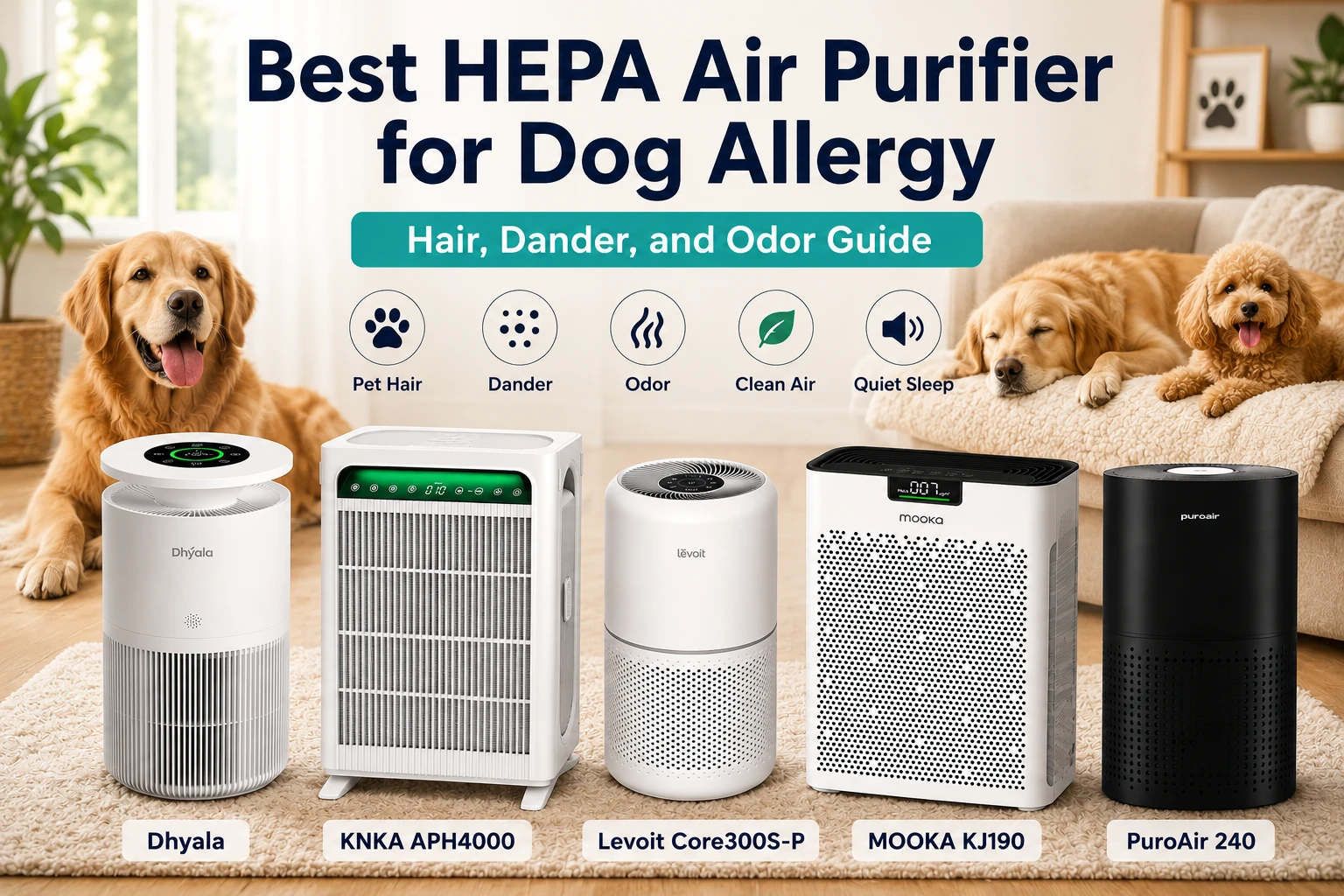
Quick Picks: Best HEPA Air Purifiers for Dog Allergy
| Product | Best For | Key Strength |
|---|---|---|
| Levoit Core300S-P | Best overall for dog allergies | AHAM Verifide, clear CADR data, smart control |
| KNKA APH4000 | Best for large rooms and dog dander | High CADR, washable pre-filter, Pet Mode |
| Dhyala Air Purifier | Best for heavy dog smell | 5-stage filtration, activated carbon, pet-focused design |
| MOOKA KJ190 | Best for dog hair | Large air intake, washable pre-filter, quiet sleep mode |
| PuroAir 240 | Best simple option for bedrooms | HEPA + carbon, auto mode, sleep mode |
What Is a HEPA Air Purifier?
HEPA stands for High Efficiency Particulate Air. A HEPA filter is designed to capture tiny airborne particles such as dust, pollen, mold spores, smoke particles, pet dander, and other fine pollutants.
A HEPA air purifier, sometimes called a HEPA air cleaner, is a device that pulls indoor air through one or more filters, traps airborne particles, and releases cleaner air back into the room.
For dog owners, this matters because many allergy triggers are not just visible dog hair. They can include tiny particles from dog dander, saliva proteins, skin flakes, dust attached to pet hair, and particles trapped in carpets, sofas, bedding, curtains, and clothing.
A good HEPA air purifier can help reduce airborne particles, especially when it runs continuously in the room where you spend the most time.
Do Air Purifiers Help With Dog Allergies?
Yes, air purifiers can help with dog allergies, but only if you choose the right type and use it correctly.
Dog allergy symptoms are usually not caused by dog hair alone. Dog hair can carry allergens, but the more important triggers are often dog dander, skin flakes, saliva proteins, and tiny particles that attach to dust and fabrics.
A HEPA air purifier can help by capturing airborne pet dander before it settles on surfaces or gets inhaled. However, it cannot remove allergens that are already stuck in carpets, bedding, sofas, curtains, clothing, or dog beds.
That means an air purifier should be part of a larger allergy-reduction plan. For best results, combine it with regular vacuuming, washing pet bedding, cleaning upholstery, and keeping your dog out of the bedroom if allergy symptoms are serious.
HEPA vs Carbon Filter vs Pre-Filter for Dog Owners
When choosing an air purifier for dog allergy, do not look at HEPA alone. A strong pet air purifier usually needs three layers of protection.
HEPA Filter for Dog Dander
The HEPA filter is the most important layer for dog allergy. It captures small airborne particles such as pet dander, dust, pollen, and fine debris.
If your main problem is sneezing, itchy eyes, or allergy symptoms around dogs, choose a purifier with True HEPA, H13 HEPA, or a clearly described high-efficiency particle filter.
Avoid relying too much on vague terms like “HEPA-like” or “HEPA-type.” These labels may not offer the same particle filtration performance as a real HEPA-grade filter.
Pre-Filter for Dog Hair
Dog hair is much larger and heavier than dander. A HEPA filter can catch some floating hair, but a washable pre-filter is usually more useful for pet hair.
The pre-filter catches larger particles before they reach the HEPA filter. This helps extend the life of the main filter and makes maintenance easier for homes with heavy-shedding dogs.
If you have a golden retriever, husky, German shepherd, Labrador, or multiple dogs, a washable pre-filter is a major advantage.
Activated Carbon for Dog Smell
HEPA filters are great for particles, but they are not the best solution for odor. If your home has heavy dog smell, wet dog odor, pet bedding smell, cooking odor, or smoke, you need an activated carbon filter.
Activated carbon helps absorb odor molecules and VOCs. For pet homes, the best air purifier should combine HEPA filtration with a meaningful carbon layer.
How We Chose the Best HEPA Air Purifiers for Dog Allergy
For this guide, the best products are not selected only by square-foot claims. Many air purifiers advertise very large coverage numbers, but the more useful comparison point is often CADR, which shows how much clean air the purifier can deliver.
| Factor | Weight | Why It Matters |
|---|---|---|
| Dander particle removal | 30% | Dog allergy is strongly related to airborne dander and fine particles |
| CADR / room suitability | 20% | Determines how quickly air can be cleaned |
| Pre-filter design | 15% | Important for dog hair and larger debris |
| Noise for bedroom use | 10% | Many allergy users need clean air while sleeping |
| Filter replacement cost | 10% | Affects long-term ownership cost |
| Odor control | 10% | Activated carbon matters for heavy dog smell |
| Ozone / ionizer considerations | 5% | Sensitive users may prefer ozone-free or ionizer-free operation |
Best HEPA Air Purifiers for Dog Allergy
Best Overall: Levoit Core300S-P
Levoit Core300S-P
- Verified CADR performance
- Good for dog dander and allergies
- Quiet 22 dB bedroom use
- Auto mode with PM2.5 sensing
- Smart VeSync app control
- More carbon for odor control

The Levoit Core300S-P is one of the strongest choices for people looking for a reliable HEPA air purifier for dog allergy. Its biggest advantage is transparency. It is AHAM Verifide and provides clear CADR ratings: 141 CFM for smoke, 156 CFM for dust, and 175 CFM for pollen.
That makes it easier to compare against other models. Many air purifiers only advertise large room coverage, but CADR gives a more practical idea of cleaning power.
For dog allergy users, the Core300S-P is a good fit because it combines particle filtration with activated carbon. The HEPA filter helps capture pet dander, dust, pollen, and other airborne particles, while the carbon filter helps reduce odors from pets, smoke, cooking, and everyday indoor smells.
It also has smart features, including WiFi control, the VeSync app, Alexa and Google Assistant support, Auto Mode, filter life tracking, and Sleep Mode. The Sleep Mode runs as quietly as 22 dB, which makes it suitable for bedrooms.
Best for: bedrooms, small to medium rooms, dog allergy, pet dander, smart home users.
Main advantage: AHAM Verifide and clear CADR data.
Limitation: Not the best choice for very large open spaces or multiple large dogs.
Best for Large Rooms: KNKA APH4000
KNKA APH4000
- Strong CADR for large rooms
- Good for dog hair, dander, and odors
- Dual air intake for faster circulation
- Washable pre-filter reduces maintenance
- Pet Mode boosts airflow for pet messes
- Real-time AQI display

The KNKA APH4000 is a strong option for dog owners who need more airflow and better coverage for larger rooms. It is also AHAM Verified, with a Smoke/Dust/PM2.5 CADR of 226 CFM and a Pollen CADR of 244 CFM.
For dog allergy, this matters because higher CADR can clean the air faster, especially in living rooms, open spaces, and areas where dogs spend a lot of time.
The KNKA APH4000 uses a dual front-and-back filter design with a washable pre-filter, high-efficiency filter, and activated carbon filter. This combination is useful for pet homes because it addresses three problems at once: dog hair, dog dander, and dog smell.
The washable pre-filter catches larger particles like pet hair and dust. The high-efficiency filter targets smaller airborne allergens, while the activated carbon layer helps reduce odor.
It also includes Pet Mode, which increases airflow to handle pet hair, dander, and odors. The real-time AQI display makes it easier to see indoor air quality changes, and Sleep Mode runs at about 22–24 dB.
Best for: large rooms, multiple dogs, heavy-shedding dogs, pet dander.
Main advantage: high CADR, washable pre-filter, Pet Mode.
Limitation: Filter replacement every 3–6 months may increase long-term cost.
Best for Heavy Dog Smell: Dhyala Air Purifier
Dhyala Air Purifier
- Great for heavy dog smell
- Good for pet hair and dander
- Strong 271 CFM airflow
- Quiet 22 dB sleep mode
- Pet-friendly safety features
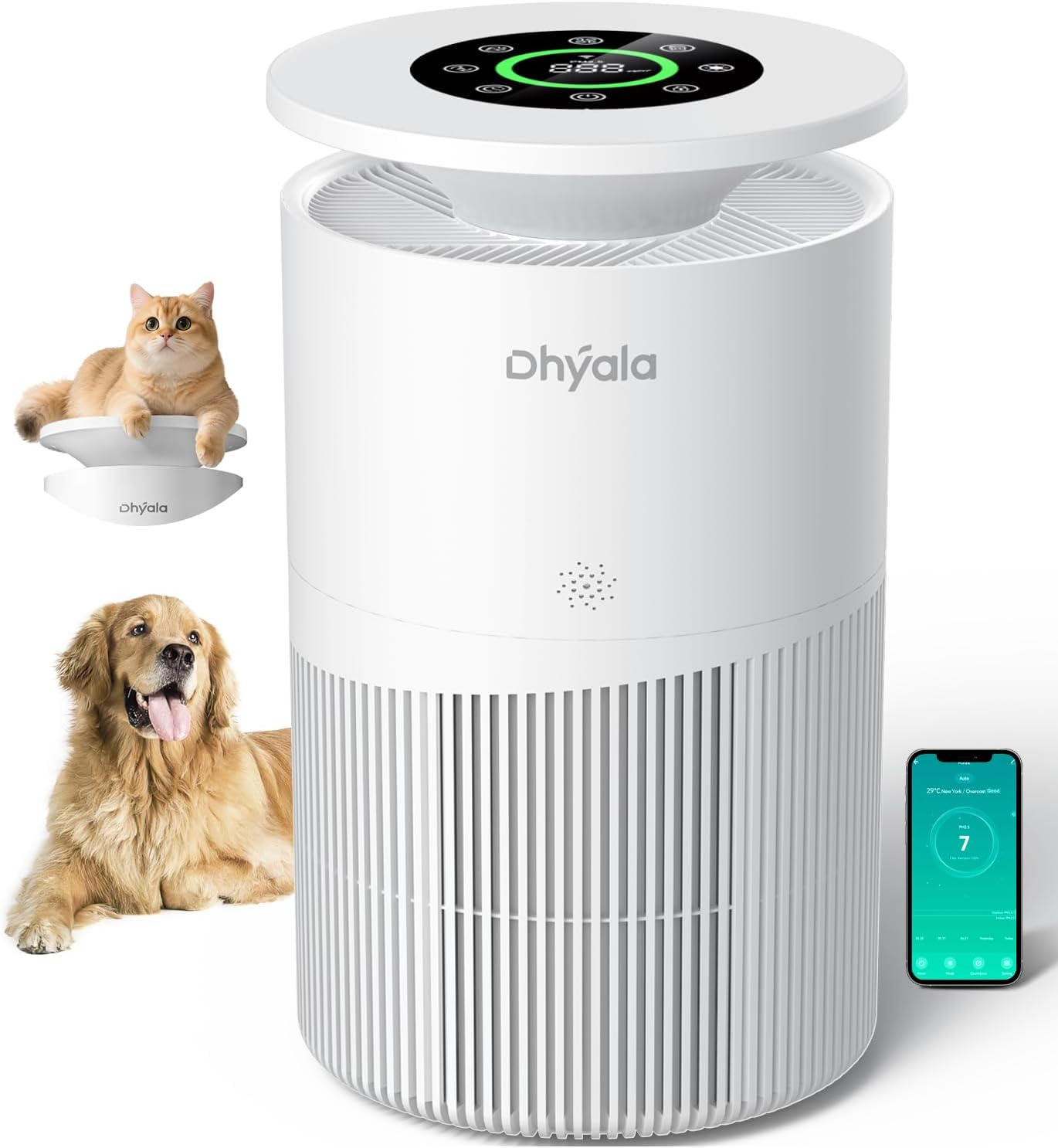
The Dhyala Air Purifier is a pet-focused model designed for homes with dog smell, pet hair, dander, smoke, cooking odor, and large-room needs. It features a 5-stage HEPA filtration system, including a pre-filter and high-efficiency activated carbon filter.
Its product description highlights a 271 CFM CADR and a maximum coverage claim of up to 3,620 sq ft in one hour. However, that large coverage number should be interpreted carefully. For comparison, the 271 CFM CADR is the more useful figure when judging performance.
For heavy dog smell, the activated carbon filter is the key feature. HEPA alone is not enough for odor control, so the carbon layer gives this model a clear advantage for pet owners who are dealing with lingering smells from dog beds, wet fur, smoke, or cooking.
It also includes several pet-friendly design details, such as a pet platform, bite-proof power cord, pet/child lock, 360-degree air intake, smart app control, voice control, Auto Mode, and Sleep Mode as low as 22 dB.
Best for: heavy dog smell, pet odor, larger living spaces, smart control.
Main advantage: strong odor-control positioning and pet-friendly design.
Limitation: The square-foot coverage claim may be more marketing-oriented than practical for high air changes per hour.
Best for Dog Hair: MOOKA KJ190
MOOKA KJ190
- Good for dog hair and odors
- Washable pre-filter saves maintenance
- Quiet 20 dB sleep mode
- Large air intake for pet homes
- Auto mode with PM2.5 display
- Ozone-free and CARB certified

The MOOKA KJ190 is a good option for dog owners who mainly struggle with floating hair, pet dust, and general indoor particles. It has a larger front air inlet and dual-side air intake, which can help pull in more airborne pet hair and dust.
Its 3-stage filtration system includes a washable pre-filter, HEPA filtration, and activated carbon pellets. The washable pre-filter is the most important feature for dog hair because it catches larger debris before it reaches the HEPA filter.
This is useful for homes with shedding dogs because it can reduce filter clogging and help lower maintenance pressure. It also includes a PM2.5 air quality display, Auto Mode, 4 fan speeds, timer settings, child lock, filter reminder, and a quiet Sleep Mode as low as 20 dB.
The product also claims coverage up to 2,200 sq ft per hour, but no clear CADR data was provided in the material. Because of that, it is better to treat it as a practical dog-hair and washable pre-filter option rather than a top scientific performance pick.
Best for: dog hair, washable pre-filter users, bedrooms, budget-friendly large-room use.
Main advantage: large air intake and washable pre-filter.
Limitation: CADR data is not clearly provided.
Best Simple Bedroom Option: PuroAir 240
PuroAir 240
- Good for pet dander and allergies
- 3-layer HEPA and carbon filtration
- Helps reduce dust, pollen, smoke, and VOCs
- Smart sensor adjusts cleaning automatically
- Quiet sleep mode for bedrooms
- CARB, ETL, ISO, and UL certified

The PuroAir 240 is a simple HEPA air purifier for bedrooms, offices, dorms, and smaller living areas. It uses a 3-layer filtration system: pre-filter, HEPA filter, and activated carbon.
This combination is useful for dog owners because the pre-filter handles larger particles, the HEPA layer captures fine airborne particles, and the carbon layer helps reduce odor and VOCs.
The PuroAir 240 claims to clean rooms up to 1,000 sq ft in one hour and includes a smart particle sensor, Auto Mode, and Sleep Mode. It is also described as CARB, ETL, ISO, and UL certified, with a 2-year warranty.
For dog allergy users, this model is best viewed as a simple, easy-to-use bedroom or office option. However, its material describes filtration as “up to 99.9% of pollutants,” not the more specific True HEPA claim of 99.97% at 0.3 microns. Because of that, it should not be described more strongly than the data supports.
Best for: bedrooms, offices, dorms, simple daily use.
Main advantage: HEPA + carbon in a simple design.
Limitation: Less transparent CADR and HEPA performance wording than Levoit or KNKA.
Product Comparison Table
| Product | Best For | CADR | Coverage Claim | Filter Type | Pet Features | Noise |
|---|---|---|---|---|---|---|
| Levoit Core300S-P | Best overall | Smoke 141 / Dust 156 / Pollen 175 CFM | Not specified in provided material | HEPA + carbon | Smart app, Auto Mode | 22 dB |
| KNKA APH4000 | Large rooms / dander | 226–244 CFM | Up to 1695 sq ft / 1 hr | Washable pre-filter + HEPA + carbon | Pet Mode, AQI display | 22–24 dB |
| Dhyala Air Purifier | Heavy dog smell | 271 CFM | Up to 3620 sq ft / 1 hr | 5-stage HEPA + carbon | Pet platform, pet lock | 22 dB |
| MOOKA KJ190 | Dog hair | Not provided | Up to 2200 sq ft / 1 hr | Washable pre-filter + HEPA + carbon | Large air intake, AQI display | 20 dB |
| PuroAir 240 | Bedroom use | Not provided | Up to 1000 sq ft / 1 hr | Pre-filter + HEPA + carbon | Auto Mode, Sleep Mode | Not provided |
CADR Comparison: Which Air Purifier Has Stronger Airflow?
CADR is more useful than a large square-foot claim because it helps show how much clean air the purifier can actually deliver. For dog allergy, higher CADR is especially helpful in larger rooms, open living spaces, and homes with multiple dogs.
| Product | CADR Data Provided | CADR Strength |
|---|---|---|
| Dhyala Air Purifier | 271 CFM | Strong |
| KNKA APH4000 | 226–244 CFM | Strong |
| Levoit Core300S-P | 141–175 CFM | Medium |
| MOOKA KJ190 | Not provided | Unknown |
| PuroAir 240 | Not provided | Unknown |
A purifier with unknown CADR is not automatically bad, but it is harder to compare. If two products look similar, the one with verified CADR data is usually the safer choice for allergy-focused buyers.
Pet-Focused Performance Ratings
The following ratings are editorial estimates based on the provided specifications, filtration design, CADR transparency, and pet-focused features. They are not laboratory test scores.
| Product | Dog Hair | Dog Dander | Dog Smell | Bedroom Use | CADR Transparency |
|---|---|---|---|---|---|
| Levoit Core300S-P | ★★★★☆ | ★★★★★ | ★★★★☆ | ★★★★★ | ★★★★★ |
| KNKA APH4000 | ★★★★★ | ★★★★★ | ★★★★☆ | ★★★★☆ | ★★★★★ |
| Dhyala Air Purifier | ★★★★☆ | ★★★★☆ | ★★★★★ | ★★★★☆ | ★★★★☆ |
| MOOKA KJ190 | ★★★★★ | ★★★☆☆ | ★★★★☆ | ★★★★★ | ★★☆☆☆ |
| PuroAir 240 | ★★★☆☆ | ★★★★☆ | ★★★☆☆ | ★★★★☆ | ★★☆☆☆ |
Filter Replacement Cost Comparison
Filter cost is especially important for dog owners because pet hair and dander can clog filters faster than normal household dust. In many pet homes, filters may need to be replaced every 3 to 6 months, depending on shedding level, room dust, fan speed, and daily runtime.
Before buying, check the price and availability of replacement filters. A cheaper air purifier can become more expensive over time if its filters are costly, hard to find, or need frequent replacement.
| Product | Suggested Filter Life | Annual Filter Cost | Notes |
|---|---|---|---|
| Levoit Core300S-P | Usually around 6–8 months, depending on use | Check current filter price | Use genuine Levoit filters for best fit and performance |
| KNKA APH4000 | 3–6 months | Check current filter price | Pet homes may need more frequent replacement |
| Dhyala Air Purifier | Not clearly provided in the material | Check current filter price | Larger filters may cost more |
| MOOKA KJ190 | Filter reminder after around 2000 hours | Check current filter price | Washable pre-filter may help extend HEPA filter life |
| PuroAir 240 | Not clearly provided in the material | Check current filter price | Check replacement filter availability before buying |
If you want the lowest long-term cost, do not only compare the machine price. Compare the machine price plus one year of replacement filters.
How to Choose a HEPA Air Purifier for Dog Allergy
Choose the Right CADR
CADR is one of the most useful numbers when comparing air purifiers. Higher CADR usually means faster air cleaning. If you have a large living room or multiple dogs, choose a model with stronger CADR rather than relying only on oversized square-foot claims.
Look for a Washable Pre-Filter
A washable pre-filter is especially useful for dog hair. It catches large particles before they clog the HEPA filter. This is important for homes with heavy-shedding dogs.
A washable pre-filter can also reduce maintenance pressure because you can clean it regularly instead of forcing the main HEPA filter to handle all the hair and larger dust.
Use Activated Carbon for Dog Odor
If your main problem is dog smell, choose a model with activated carbon. HEPA helps with particles, but carbon is the layer that helps reduce odors.
For heavy dog smell, look for a purifier that clearly mentions activated carbon, carbon pellets, or a high-efficiency carbon filter. Thin carbon sheets may help with light odors, but they may not be enough for strong pet odor.
Do You Need H13 or H14 HEPA for Dog Allergies?
For most homes with dogs, a True HEPA or H13 HEPA filter is already enough for reducing airborne pet dander, dust, pollen, and fine particles. You do not always need to chase the highest HEPA grade.
In theory, H14 HEPA can offer higher filtration efficiency than H13, but in a home air purifier, filtration grade is only one part of performance. If the filter is too dense, it may increase air resistance, reduce airflow, raise noise levels, and lower the number of air changes per hour.
For dog allergy relief, a balanced purifier with strong CADR, good airflow, a washable pre-filter, and activated carbon is usually more practical than simply choosing the highest HEPA grade on paper.
Be Careful With Ionizers
Some air purifiers include ionizers, plasma features, or other electronic air-cleaning functions. People with allergies or asthma may prefer an ozone-free model or a purifier where the ionizer can be turned off.
If you are sensitive to air quality, check whether the product is CARB compliant, whether it produces ozone, and whether any ionizer feature is optional.
Check Filter Costs
A cheaper air purifier is not always cheaper long term. Check how often the filter needs to be replaced and how much replacement filters cost.
This is especially important for pet homes because dog hair and dander can shorten filter life. If you have more than one dog or a heavy-shedding breed, filter cost should be part of your buying decision.
Where Should You Place an Air Purifier If You Have a Dog?
For dog allergies, placement matters.
The best place is usually the room where symptoms are worst. For many people, that is the bedroom. Running an air purifier in the bedroom can help reduce airborne dander while you sleep.
You can also place one near the dog’s main activity area, such as the living room or near the dog bed. However, do not block the air intake or place the purifier directly against a wall or furniture.
For larger homes or multi-level houses, one air purifier may not be enough. It is often better to use one appropriately sized purifier in each important room rather than expecting one machine to clean the entire house.
How to Reduce Dog Allergens Beyond Air Purification
An air purifier can reduce airborne allergens, but it cannot solve everything. For better results, combine it with these steps.
Use a HEPA vacuum regularly, especially on carpets, sofas, and rugs. Wash dog bedding often. Clean curtains, blankets, and fabric surfaces where dander can settle. Keep dogs out of the bedroom if symptoms are serious. Maintain HVAC filters and consider using higher-quality filters if your system supports them.
You can also brush your dog regularly, clean the dog’s favorite resting spots, and reduce dust buildup around baseboards, corners, and fabric furniture.
Also remember that allergy symptoms can be personal and sometimes serious. If symptoms are strong or persistent, speak with a doctor or allergy specialist.
FAQs
Can a HEPA filter remove dog dander?
Yes. A good HEPA filter can capture airborne dog dander and other fine particles. However, it cannot remove dander already settled on carpets, bedding, or furniture.
Can an air purifier remove dog hair?
It can capture some floating dog hair, especially if the purifier has strong airflow and a washable pre-filter. But it will not replace vacuuming or brushing your dog.
Do air purifiers help with dog smell?
Yes, but only if they include activated carbon. HEPA filters mainly capture particles, while activated carbon helps reduce odors.
Is H13 HEPA necessary for dog allergies?
H13 HEPA can be helpful, but it is not the only factor. CADR, room size, pre-filter design, carbon filtration, and proper use are also important.
Is H14 HEPA better than H13 for dog allergy?
Not always. H14 can have higher filtration efficiency on paper, but it may also increase air resistance if the purifier is not designed well. For most homes, H13 or True HEPA with strong CADR is more practical.
Should I run an air purifier all day?
For allergy control, continuous operation is usually better than occasional use. Auto Mode or low fan speed can help maintain cleaner air throughout the day and night.
Can an air purifier replace allergy medication?
No. An air purifier can reduce airborne allergens, but it should not be treated as a medical replacement. For serious allergy symptoms, consult a healthcare professional.
Final Verdict
The best HEPA air purifier for dog allergy should do more than just claim large room coverage. It should have strong particle filtration for dog dander, enough CADR for your room, a washable pre-filter for dog hair, activated carbon for dog smell, quiet operation for bedrooms, reasonable filter costs, and safe operation for sensitive users.
For most people, the Levoit Core300S-P is the best overall choice because it has AHAM Verifide performance data, clear CADR ratings, smart control, carbon filtration, and quiet Sleep Mode.
For larger rooms or heavier pet dander problems, the KNKA APH4000 is also a strong option thanks to its higher CADR, washable pre-filter, and Pet Mode.
For heavy dog smell, the Dhyala Air Purifier is worth considering because of its activated carbon and pet-focused design, but its large coverage claim should be interpreted carefully.
No air purifier can remove every dog allergen from your home, but the right HEPA air purifier can make a noticeable difference when combined with regular cleaning, dog bedding care, vacuuming, and smart placement.