Best Air Purifiers for Pet Allergies 2025 – HEPA Filter Guide & Top Picks for Cat and Dog Owners
If you share your home with cats or dogs, you know the joy they bring — and also the sneezing, itchy eyes, or congestion that may follow. Pet allergies are triggered by microscopic proteins found in pet dander, saliva, and urine that float through the air and stick to surfaces. These particles are so small and light that they can stay airborne for hours, easily spreading throughout your home.
That’s where air purifiers come in. But not all purifiers are equally effective. The secret lies in understanding how air purifiers work, especially the filters they use and the features that make them efficient against pet allergens.
What Is HEPA and How Does It Work?
HEPA stands for High Efficiency Particulate Air filter. It’s the gold standard in air purification, capable of trapping 99.97% of airborne particles as small as 0.3 microns — including pet dander, dust, pollen, and even bacteria.
What’s Inside a HEPA Filter?
HEPA filters are made from ultra-fine fibers arranged in a dense mat. Common materials include:
- PP (Polypropylene) filter paper — cost-effective but not washable.
- PET or PTFE filters — washable but typically less efficient.
- Fiberglass HEPA — the most effective and widely used in medical and home applications.
The fibers create a maze where particles are trapped through interception, impaction, and diffusion — not like a sieve, but more like a sticky web. Interestingly, HEPA is most effective for particles larger than 0.5 μm and smaller than 0.1 μm, while particles around 0.3 μm are the hardest to capture, known as the “Most Penetrating Particle Size” (MPPS).
HEPA Filter Grades Explained
The U.S. Department of Energy (DOE) defines HEPA as capturing at least 99.97% of 0.3 μm particles.Europe’s EN1822:2009 standard further classifies filters into multiple grades:
| Grade | Efficiency | Common Use |
|---|---|---|
| H10–H12 | 85–99.5% | Basic purifiers |
| H13 | 99.95% | Premium home units |
| H14 | 99.995% | Medical-grade HEPA |
| U15–U17 | 99.9995–99.999997% | Clean rooms, labs |
In household air purifiers, H13 is the sweet spot — high filtration with manageable noise and airflow.
Can HEPA Filters Capture Viruses and Bacteria?
Yes — high-grade HEPA filters can intercept most airborne bacteria and some viruses attached to droplets or dust.
In medical environments, HEPA systems are often paired with UV-C sterilization to neutralize microbes trapped on the filter surface.
For home use, a HEPA + UV-C combo can reduce the spread of cold, flu, and pet-related allergens safely — as long as the UV light is ozone-free and certified.
Why Pet Allergens Are Hard to Remove
Pet allergens are microscopic and stubborn:
- Size: 75% of cat dander particles are between 5–10 μm, and about 25% are as small as 2.5 μm or less.
- Stickiness: They cling to furniture, curtains, clothing, and carpets.
- Persistence: Even without direct contact with pets, allergens can spread through air currents or contaminated clothing.
That’s why an air purifier with a True HEPA filter and activated carbon layer is essential for reducing allergic reactions.
Key Features to Look for in an Air Purifier
When choosing an air purifier for pet allergies, look beyond brand names — focus on the core specs that determine performance.
(1) CADR Value (Clean Air Delivery Rate)
The CADR measures how fast a purifier can clean the air.
Higher CADR = faster purification.
You can estimate coverage area by multiplying CADR by 0.1 (e.g., 300 CADR ≈ 30 m²).
(2) CCM (Cumulative Clean Mass)
Indicates how much pollution the filter can handle before it’s saturated.
Higher CCM = longer filter life = lower maintenance cost.
(3) Purification Efficiency
This shows how much clean air is produced per watt of power.
Higher efficiency means more purification with less electricity.
(4) Noise Level
For 24/7 operation, pick purifiers under 50 dB at medium speed.
Quieter machines are more comfortable for bedrooms and pet rooms.
Buying Tip: Follow the “3 Highs + 1 Low” rule —
High CADR, High CCM, High Efficiency, and Low Noise.
The Role of Filter Design
A purifier’s structure affects airflow and performance:
- Activated Carbon Filters — absorb odors and gases like pet smells and VOCs.
Best choice: Columnar carbon (balances absorption and humidity resistance).
- HEPA Filters — capture solid particles like dander and dust.
Levels: H11 (98%), H12 (99.9%), H13 (99.97%).
Filter Structure:
- Tower-style filters are thicker and more efficient than flat filters.
- Ideal for large spaces or homes with multiple pets.
Best Air Purifiers for Pet Allergies
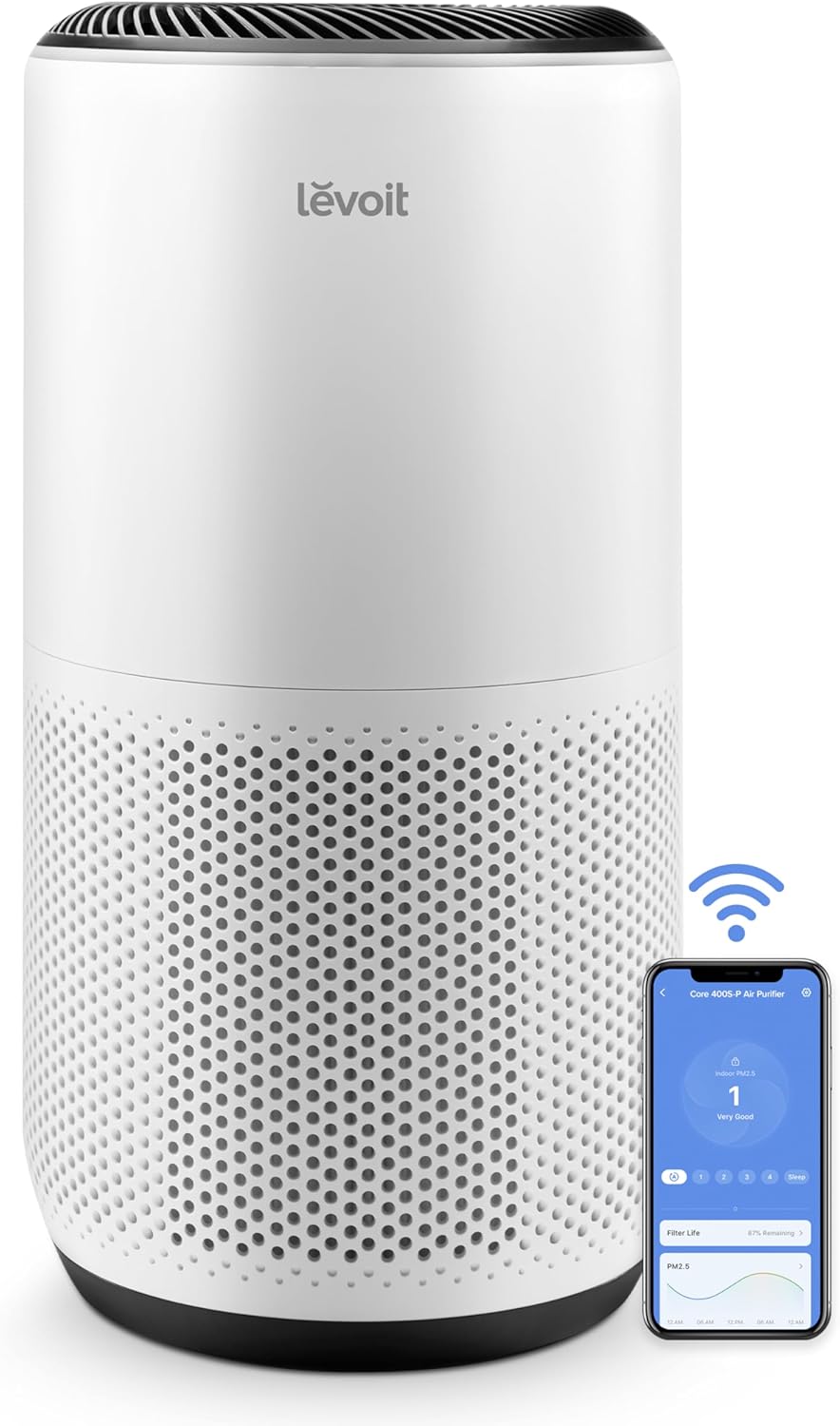
LEVOIT Core 400S-P — Best Smart HEPA Purifier
- Coverage: Up to 1,733 sq. ft
- CADR: Smoke 231 | Dust 240 | Pollen 259
- Filters: 3-in-1 system (Pre-filter + HEPA + Activated Carbon)
- Features: Auto mode, PM2.5 display, Wi-Fi, ultra-quiet sleep mode
- Why We Like It: AHAM verified, smart sensors, and excellent odor removal for cat or dog owners.
LEVOIT Air Purifiers for Home Large Room Up to 1733 Ft² With HEPA
- Brand:Air Oasis
- Product Dimensions:10.75″D x 10.04″W x 13.5″H
- Specification Met:CARB Certified, ETL Certified
Air Oasis iAdaptAir 2.0 — Medical-Grade Filtration
- Coverage: 1,325 sq. ft
- Technology: 5-stage system (HEPA H13, Carbon, Silver Ion, UV Light, Ionization)
- Performance: Removes 99% of viruses, mold, dust, and allergens down to 0.05 microns
- Smart Features: Wi-Fi control, air-quality sensor, auto fan speed
- Why We Like It: Hospital-grade purification with one of the highest CADR values in its class.
Air Oasis iAdaptAir 2.0 H13 HEPA Filter Air Purifier
- Brand:Air Oasis
- Product Dimensions:10.75″D x 10.04″W x 13.5″H
- Specification Met:CARB Certified, ETL Certified

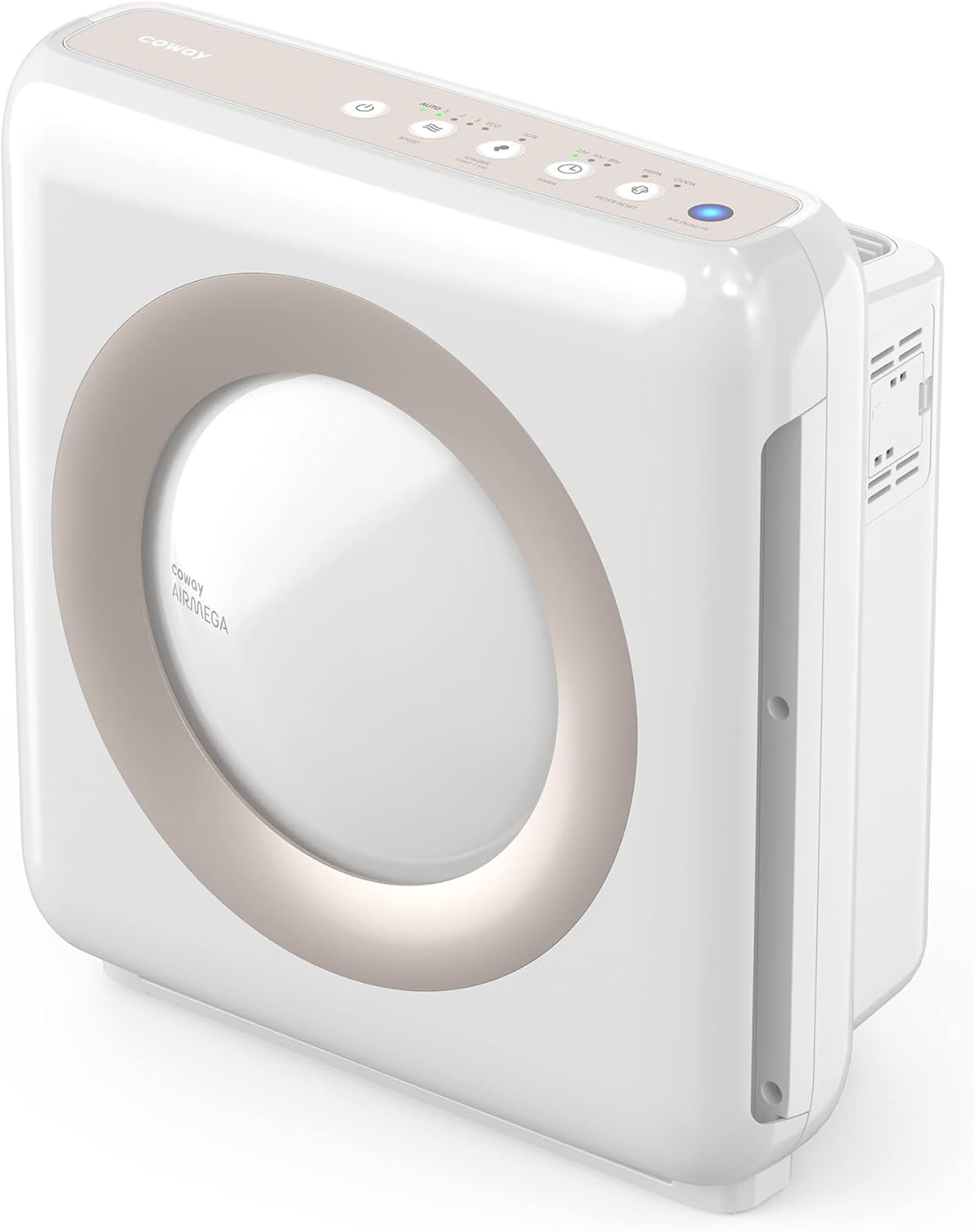
Coway Airmega AP-1512HH — Reliable Everyday Choice
- Coverage: 361 sq. ft (CADR 240)
- System: 4-stage filtration (Pre-filter, Deodorization, True HEPA, Vital Ion)
- Highlights: Auto + Eco mode, real-time air quality LED, quiet operation (24–53 dB)
- Why We Like It: Proven long-term reliability, ideal for bedrooms and smaller homes.
Coway Airmega AP-1512HH(W) True HEPA Purifier
- Brand:Coway
- Product Dimensions:9.6″D x 16.8″W x 18.3″H
- Floor Area:361 Square Feet
- Specification Met:CARB Certified, ETL Certified
Maintenance Tips for Longevity
- Replace HEPA filters every 6–12 months (or 6 months if you have multiple pets).
- Wash pre-filters every 2–4 weeks.
- Keep air inlets unobstructed for better airflow.
- Always buy original replacement filters to ensure correct fit and efficiency.
FAQ — Air Purifiers for Pet Allergies
Q1: Can air purifiers completely remove pet allergens?
They can significantly reduce allergens but not eliminate them 100%. Regular cleaning and pet grooming are also important.
Q2: Are washable filters as effective as True HEPA?
No. Washable filters trap larger debris, but True HEPA is needed for microscopic dander and allergens.
Q3: How often should filters be changed in a multi-pet household?
Every 6 months, or sooner if you notice reduced airflow or odor.
Q4: Do air purifiers with ionizers produce ozone?
Some older ones do. Always choose ozone-free certified models for safety.
Q5: Which filter combination works best for pet owners?
Pre-filter + H13 HEPA + Activated Carbon is ideal — captures fur, dander, and odor simultaneously.
Q6: Can HEPA filters trap viruses?
Yes, most viruses attached to droplets or dust are captured. For extra protection, choose units with UV-C sterilization.
Final Thoughts
Understanding how air purifiers work helps you choose wisely. For pet allergies, focus on:
- True HEPA (H13 or higher)
- Activated Carbon for odor control
- High CADR + Quiet Operation
With the right purifier, you can breathe easier, reduce allergy symptoms, and enjoy life with your furry friends — without the sneezing.